
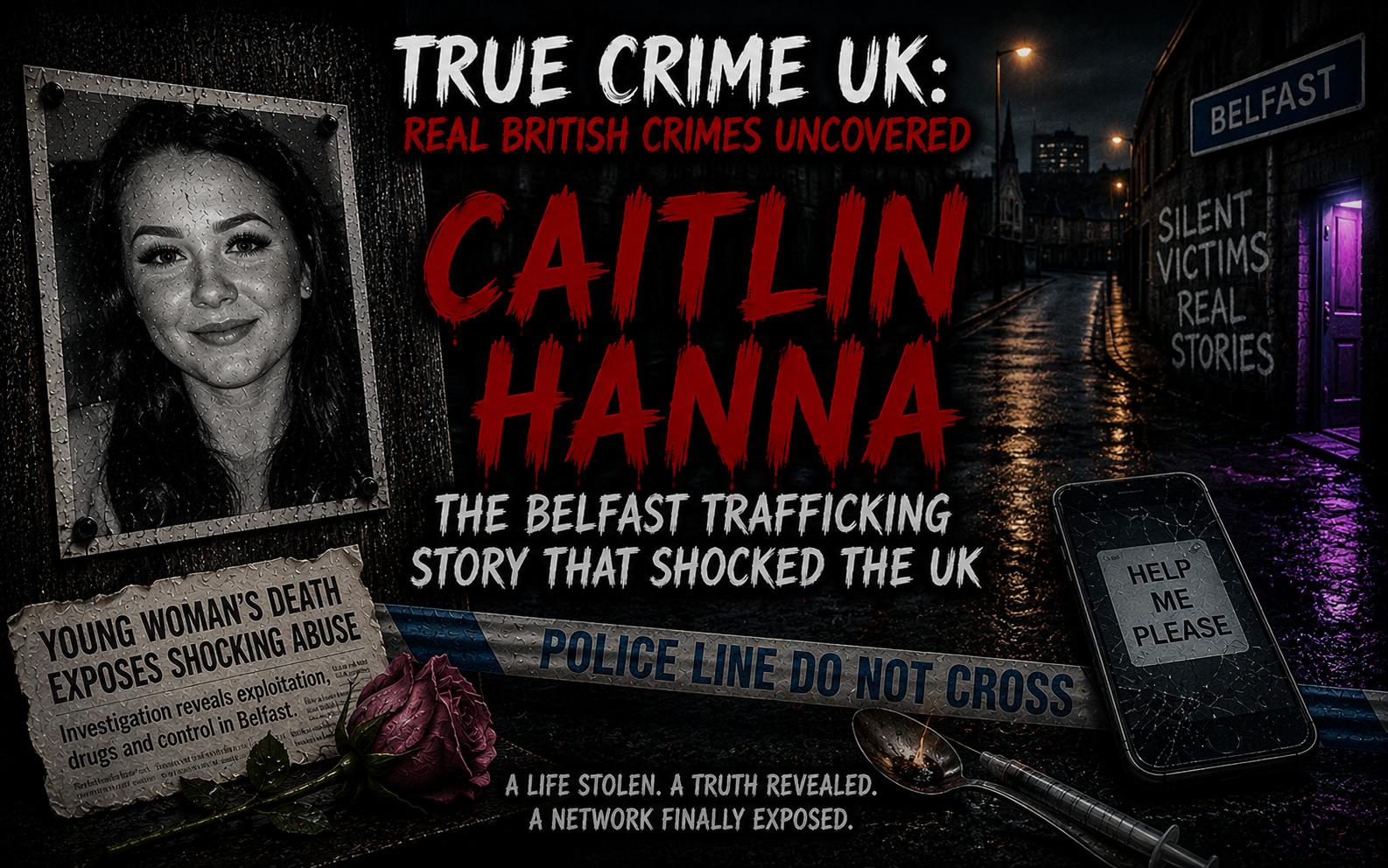
The tragic story of Caitlin Hanna exposed a hidden criminal underworld operating quietly in Belfast and forced many people across the UK to confront the brutal realities of exploitation, addiction, and human trafficking.
Unlike many traditional true crime cases centred around serial killers or violent abductions, the Caitlin Hanna story unfolded slowly and painfully behind closed doors. It involved grooming, coercion, addiction, sexual exploitation, and vulnerable young women being manipulated by older men operating within organised criminal circles.
When Caitlin died in 2022 at just 21 years old, her family initially believed they had lost their daughter to drugs. But as police investigated further, a much darker picture emerged.
The case would eventually lead to multiple convictions and inspire a major BBC documentary that shocked viewers across Britain and Ireland.
More importantly, it revealed how trafficking and exploitation can thrive in ordinary communities while remaining almost invisible to the outside world.
Who Was Caitlin Hanna.
Friends and family described Caitlin Hanna as bright, caring, funny, and full of energy before her life spiralled into addiction and exploitation.
Raised in Belfast, Caitlin reportedly enjoyed school, had ambitions for the future, and maintained strong relationships with those closest to her during her teenage years. Like many young people, she experienced normal ups and downs growing up, but few around her could have predicted the devastating path her life would eventually take.
According to people who knew her, Caitlin’s vulnerability increased during her late teenage years as she became involved with drugs and dangerous social circles.
Investigators later believed traffickers deliberately targeted those vulnerabilities.
The tragedy surrounding Caitlin Hanna is particularly disturbing because her exploitation allegedly developed gradually. Family members later explained they did not initially realise the extent of what was happening behind the scenes.
By the time the truth emerged, the damage had already become catastrophic.
Grooming and Exploitation in Belfast.
Police later alleged Caitlin had been groomed and controlled by older men connected to organised criminal activity in Belfast.
Central to the investigation was Derek Brown, a man prosecutors accused of exploiting vulnerable women through drugs, intimidation, and manipulation.
According to investigators, Caitlin became trapped in a cycle where addiction and exploitation reinforced one another. Drugs allegedly became both a method of control and a way to maintain dependence.
Women involved in the investigation later described how traffickers targeted young women struggling emotionally or financially before isolating and exploiting them.
The situation was not simply prostitution in the traditional sense.
Police and support organisations instead described it as organised sexual exploitation involving coercion, addiction, manipulation, and fear.
As Caitlin’s life deteriorated, those closest to her reportedly struggled to understand exactly what was happening.
Friends later recalled seeing dramatic changes in her behaviour, appearance, and mental health.
Her family watched helplessly as she slipped deeper into addiction.
A Life Falling Apart.
In the months leading up to her death, Caitlin Hanna’s life reportedly became increasingly chaotic.
Family members later described repeated interactions with police, concerns about dangerous individuals surrounding her, and growing fears for her safety.
According to interviews featured in later documentaries and media coverage, Caitlin’s mother became deeply alarmed by the men entering her daughter’s life.
At times, Caitlin allegedly appeared frightened and emotionally exhausted.
Despite efforts from loved ones to help her escape the situation, investigators believe the grip of addiction and coercion made leaving extraordinarily difficult.
Experts on trafficking often describe this as one of the most misunderstood aspects of exploitation.
Victims can become emotionally dependent on those abusing them, particularly when drugs, manipulation, threats, and emotional isolation are involved.
By 2022, Caitlin’s health and wellbeing had reportedly deteriorated severely.
Then came the moment that changed everything.
The Death of Caitlin Hanna.
In 2022, Caitlin Hanna died from a drug overdose.
Post-mortem findings later revealed a combination of substances in her system, including methadone and other powerful drugs linked to addiction and dependency.
At first glance, her death risked becoming another tragic overdose statistic.
But investigators soon began uncovering evidence suggesting Caitlin’s death formed part of a much larger pattern of exploitation and abuse.
Police launched a wider investigation into the individuals surrounding her during the final stages of her life.
What detectives uncovered shocked even experienced officers.
Behind the scenes, they alleged, vulnerable young women had been trafficked, manipulated, and sexually exploited by organised offenders operating in Belfast.
Caitlin Hanna’s death became the catalyst that finally exposed the network.
The Police Investigation.
The Police Service of Northern Ireland launched a major investigation into organised sexual exploitation following Caitlin’s death.
Detectives spent years gathering evidence, interviewing witnesses, examining digital communications, and building cases against those involved.
One of the most significant developments came when other women began speaking to police.
Several survivors reportedly came forward describing similar patterns of grooming, drug dependency, and exploitation linked to men operating within the same circles connected to Caitlin.
Their testimony proved crucial.
Investigators later explained that without victims and survivors speaking openly, many trafficking networks remain hidden indefinitely.
Police alleged women were being controlled through heroin addiction, emotional manipulation, intimidation, and financial dependence.
The investigation revealed what authorities described as a deeply disturbing criminal underworld operating largely unnoticed within Belfast.
For many people watching developments unfold, the case shattered assumptions about trafficking only happening overseas or within major organised crime syndicates.
Instead, it appeared to be happening within ordinary neighbourhoods and communities.
Derek Brown and the Court Proceedings.
Among those convicted following the investigation was Derek Brown.
Prosecutors alleged Brown trafficked, exploited, and abused vulnerable women, including Caitlin Hanna.
Court proceedings revealed disturbing details surrounding how addiction and exploitation allegedly intersected within the criminal operation.
According to reports surrounding the case, women were supplied with drugs while simultaneously being sexually exploited and controlled.
Brown later received a prison sentence connected to trafficking and exploitation offences.
The convictions represented an important moment for both police and survivors who had spent years trying to expose the abuse taking place.
However, many observers noted the sentences could never undo the devastation experienced by Caitlin Hanna and other vulnerable women caught within the system.
Why the Caitlin Hanna Case Resonated So Deeply.
One reason the Caitlin Hanna story affected so many people is because it felt painfully real and frighteningly close to home.
This was not a distant organised crime story involving international gangs or dramatic kidnappings.
Instead, the case highlighted how exploitation can quietly develop in everyday communities through grooming, addiction, emotional control, and vulnerability.
Many viewers of the later BBC documentary described the story as deeply upsetting because Caitlin appeared relatable to ordinary young people across the UK.
The documentary featured emotional testimony from family members, police investigators, and survivors connected to the case.
For audiences, the story became not only about crime, but about loss, manipulation, and the failure to recognise exploitation before it becomes deadly.
The case also triggered wider conversations surrounding addiction treatment, safeguarding vulnerable women, and how trafficking victims are often misunderstood by society.
The Hidden Reality of Trafficking.
Experts involved in anti-trafficking work have repeatedly stressed that cases like Caitlin Hanna’s are often far more common than many people realise.
Victims are not always physically imprisoned or violently abducted.
Instead, traffickers frequently use emotional dependency, drugs, financial pressure, fear, and psychological control to maintain influence over vulnerable individuals.
In many cases, victims may not initially recognise themselves as being trafficked.
This makes investigations incredibly difficult.
Support workers connected to the Caitlin Hanna case later emphasised how addiction often becomes weaponised by traffickers, creating cycles that are extremely difficult for victims to escape alone.
The case therefore became a broader warning about exploitation hidden beneath addiction crises across parts of the UK and Ireland.
Public Reaction to the BBC Documentary.
The release of the BBC documentary "Caitlin Hanna: Trafficked in Belfast" introduced the case to a much wider audience.
Viewers described the programme as heartbreaking, disturbing, and emotionally overwhelming.
Many people were particularly affected by interviews with Caitlin’s family, who spoke openly about watching her decline while struggling to understand the true scale of the exploitation surrounding her.
The documentary also highlighted the bravery of survivors who eventually came forward to expose the criminal network.
Without their testimony, investigators may never have uncovered the broader operation allegedly targeting vulnerable women in Belfast.
Public reaction online reflected widespread anger toward the traffickers involved and sadness over how Caitlin’s life ended.
For many viewers, the documentary transformed what might otherwise have been viewed simply as a drug-related death into a much larger story about exploitation and systemic vulnerability.
The Lasting Legacy of Caitlin Hanna.
Today, Caitlin Hanna’s story continues resonating across the UK and Ireland because it exposed uncomfortable truths about trafficking, addiction, and hidden exploitation.
Her death forced authorities and communities to confront the reality that organised abuse can operate in plain sight while vulnerable people remain trapped behind fear and dependency.
The case also highlighted the importance of survivor testimony and the role families play in pushing for justice even after unimaginable loss.
For many people following the story, Caitlin Hanna became more than simply another victim in a true crime case.
She became a symbol of how easily vulnerable young people can be manipulated by dangerous individuals who exploit addiction and emotional fragility for profit and control.
Although convictions were eventually secured, the emotional damage caused by the case continues to affect families, survivors, investigators, and communities connected to the tragedy.
Her story remains one of the most disturbing and emotionally devastating modern true crime cases connected to Northern Ireland.
Do you believe enough is being done in the UK to identify and stop hidden trafficking networks targeting vulnerable young people?
Crime News
Caitlin Hanna Case - The Belfast Trafficking Story That Shocked the UK
Advertisement



Comments (0)
You must be logged in to post comments.
Don't have an account? Register here
No comments yet. Be the first to share your thoughts!