
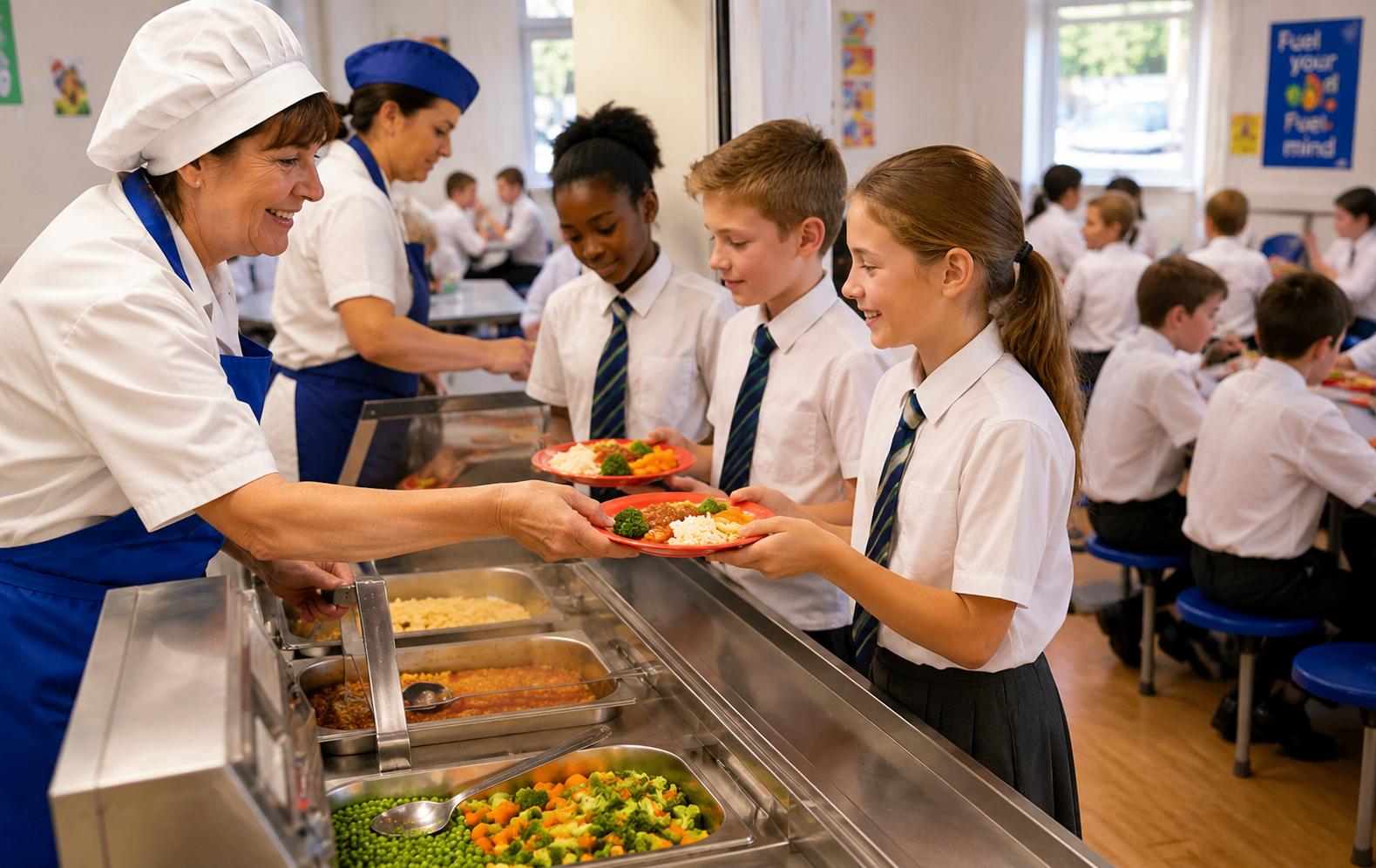
The UK government has unveiled sweeping plans to transform school meals across England, with deep-fried foods set to disappear from menus and sugary desserts facing strict new limits under a nationwide healthy eating crackdown.
The proposed reforms, described by ministers as the biggest update to school food standards in more than a decade, aim to tackle rising childhood obesity, poor nutrition and diet-related health issues among children. If approved, the measures will apply to both primary and secondary schools from September 2027.
Under the new guidance, schools will no longer be allowed to serve unhealthy grab-and-go options such as pizza, sausage rolls and other heavily processed foods every day. Instead, fruit, vegetables and wholegrain options will take a much more prominent role in school canteens.
Education Secretary Bridget Phillipson called the proposals “the most ambitious overhaul of school food in a generation” as the government looks to improve the quality of meals served to millions of pupils each day.
Fruit and Healthier Meals to Replace Sugary School Foods.
One of the biggest changes in the proposed school dinner reforms is the restriction of high-sugar desserts. Sweet treats will be limited to once per week, while schools will be encouraged to provide healthier alternatives including fresh fruit and fibre-rich snacks for the majority of the school week.
The Department for Education said the changes are designed to help children develop healthier eating habits from an early age while improving concentration and learning outcomes in classrooms.
According to government figures, more than one in three children leave primary school overweight or obese. Officials also highlighted that tooth decay caused by excessive sugar consumption remains the leading cause of hospital admissions among children aged five to nine in England.
Early Education Minister Olivia Bailey said the reforms are intended to “kickstart a transformation of school food” by reducing sugar levels, increasing fibre intake and removing some of the least healthy options currently available to pupils.
Bailey also confirmed that schools will be expected to publish their menus online to improve transparency for parents.
Schools Face Questions Over Funding and Rising Food Costs.
While many education and health organisations have welcomed the plans, concerns remain about whether schools will receive enough financial support to deliver the changes effectively.
The Association of School and College Leaders backed the push for healthier meals but warned that additional funding would be essential if schools are expected to meet the tougher standards without affecting budgets elsewhere.
Tom Middlehurst from the organisation said improving school food quality was “something we wholeheartedly support” but stressed that implementation must be practical and properly funded.
Concerns over funding pressures have grown in recent years as schools struggle with rising food prices and catering costs. A 2025 survey from school catering organisation School Food People suggested the real cost of providing a school meal is around £3.45 per pupil. However, most schools in England currently receive only £2.61 in funding for free school meals.
Many schools have reportedly been forced to reduce portion sizes or purchase cheaper ingredients in order to stay within budget.
The Liberal Democrats also raised concerns about funding levels, arguing that healthy eating reforms can only succeed if schools receive enough financial support to cover increasing food costs.
Education spokesperson Munira Wilson said many parents, teachers and governors are worried that current funding arrangements are no longer sustainable.
Government Says Healthier Food Does Not Need to Cost More.
Despite the concerns, Prime Minister Keir Starmer insisted schools should be able to manage the changes within their existing budgets.
Speaking on BBC Radio 5 Live, Starmer said he believed schools could successfully introduce healthier meals without major additional costs.
Ministers argue that healthier food choices do not automatically mean more expensive catering and say schools can still provide balanced meals while reducing unhealthy ingredients and processed foods.
The government has also announced a phased introduction for some secondary school changes, allowing catering teams time to develop new recipes, update menus and train kitchen staff before the standards become mandatory.
A nine-week public consultation has now been launched before the final rules are confirmed in September this year.
Free School Meals Expansion and Breakfast Clubs Included.
Alongside the school food reforms, the government confirmed that free school meals will be expanded from September 2026 to include all children whose parents receive Universal Credit.
Officials estimate the policy will make an additional 500,000 children eligible for free meals across England.
The Department for Education also announced the rollout of more than 500 new free breakfast clubs, designed to provide children with healthy meals before the school day begins.
Funding for breakfast clubs has increased from 60p to £1 per pupil after schools raised concerns over affordability.
Campaigners have long argued that access to healthy meals at school plays a major role in improving educational performance, attendance and long-term health outcomes for children from lower-income families.
Political Reactions Divide Opinion on School Food Plans.
Reaction to the proposed changes has varied across the political spectrum.
The Green Party welcomed the reforms and described the removal of unhealthy foods from school menus as “long overdue”. The party also called for universal free healthy meals for all primary and secondary school pupils.
Meanwhile, Reform UK criticised the plans, accusing the government of trying to “micromanage people’s lives” through restrictions on school menus.
The party argued that education and affordability should take priority over food bans, saying families should be supported in making healthier choices rather than having options removed entirely.
The Conservatives have not yet formally responded to the proposals.
New School Food Standards Could Reshape Children’s Health in England.
The proposed reforms mark the first major update to England’s school food standards since 2015 and could significantly reshape the way millions of children eat during the school day.
With childhood obesity, food insecurity and rising living costs continuing to dominate public debate, the success of the new measures may depend heavily on whether schools receive enough support to deliver healthier meals consistently and affordably.
The final standards are expected to come into force in September 2027 following consultation and further review.
What do you think about England’s new school dinner plans? Should unhealthy foods be removed from school menus completely, or should schools offer more choice to pupils and parents?
Share your thoughts in the comments below and join the conversation on healthy school meals, child nutrition and the future of education in England.
Food & Drink News
England School Dinner Overhaul to Ban Deep-Fried Foods and Restrict Sugary Desserts in Major Healthy Eating Push
Advertisement


Comments (0)
You must be logged in to post comments.
Don't have an account? Register here
No comments yet. Be the first to share your thoughts!