
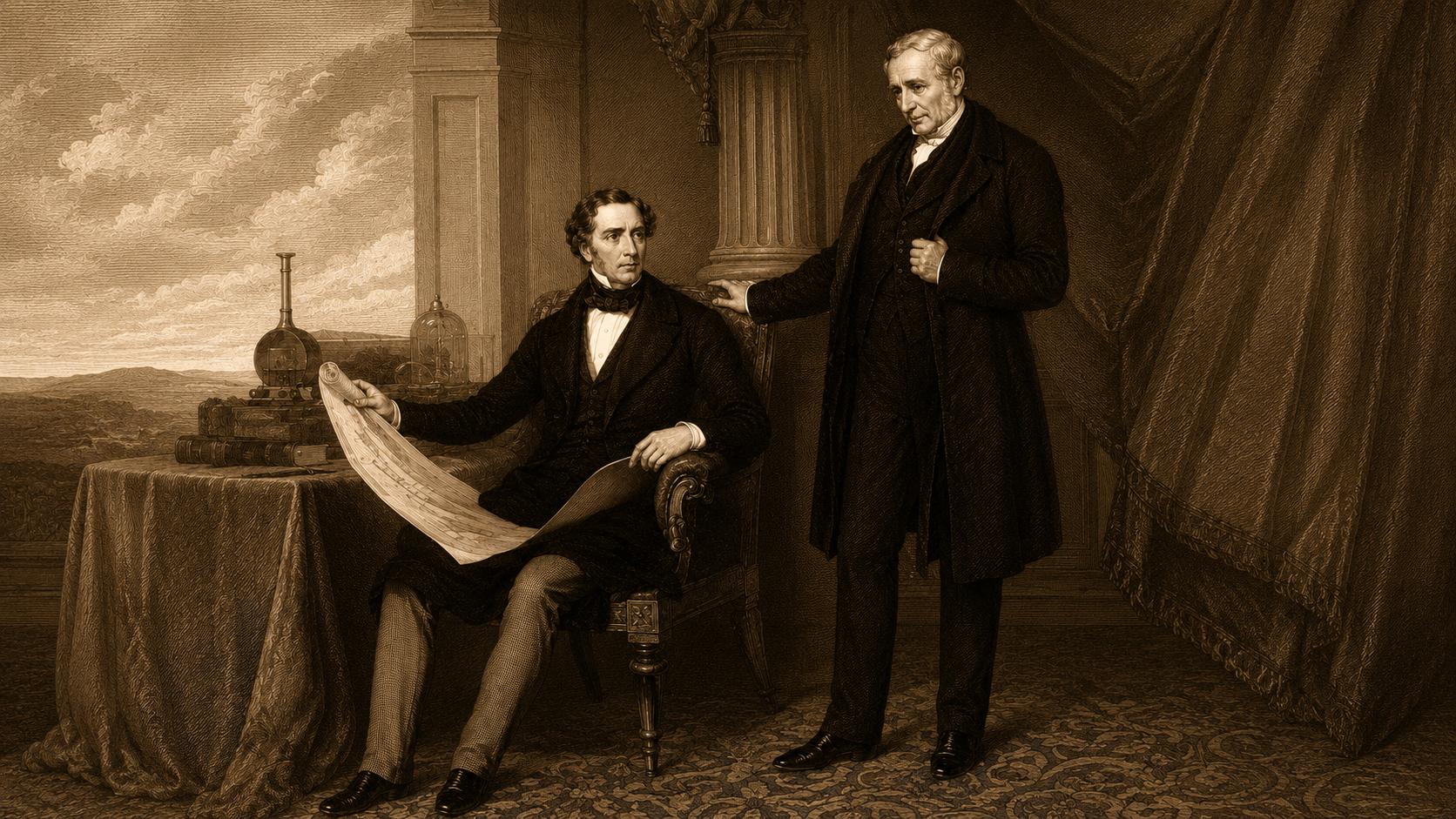
The railway is one of the great inventions in human history, and it owes much to two men from the North East of England. George Stephenson and his son Robert, working from Newcastle and the surrounding coalfields, did more than almost anyone to turn the steam locomotive from an experimental curiosity into a practical technology that would transform the world. The first purpose-built locomotive works in history stood in Newcastle, and from it came engines that launched the railway age.
A Self-Made Engineer.
George Stephenson was born in 1781 in the village of Wylam, just west of Newcastle, the son of a colliery worker. Largely self-educated, he learned to read as a young man and rose through hard work and natural ability to become an engineer at the local collieries. The mines of the North East were the cradle of the early railways, for they needed an efficient way to move heavy coal, and it was here that Stephenson developed his expertise. He built early locomotives to haul coal and also invented a miners' safety lamp, demonstrating the practical genius that would define his career.
The Stockton and Darlington Railway.
Stephenson's reputation grew, and he was appointed engineer of a project that would change history. The Stockton and Darlington Railway, which opened in 1825, was the world's first public railway to use steam locomotives, and it proved that steam-hauled rail transport was a practical reality. The success of the line captured the imagination of the age and set in motion a railway revolution that would spread across Britain and then the world. Stephenson had shown that the new technology could carry goods and passengers on a scale never before imagined.
The Liverpool and Manchester Triumph.
The crowning achievement of George Stephenson's career came with the Liverpool and Manchester Railway, which opened in 1830 as the first railway to connect two major cities entirely by steam power. To choose the locomotives for the line, a famous competition was held, and the engine that triumphed was the Rocket, built by the Stephensons. The Rocket's victory established the design principles that locomotives would follow for generations and confirmed the Stephensons as the leading engineers of the railway age. The modern railway had truly arrived.
Robert Stephenson, a Worthy Heir.
George's son Robert, born in 1803, became one of the greatest engineers of the nineteenth century in his own right. He played a central role in the design and building of the Rocket and went on to a brilliant career, particularly as a builder of bridges. His great structures included the High Level Bridge in Newcastle and the Royal Border Bridge at Berwick, masterpieces of engineering that still stand today, as well as major bridges far beyond Britain. Robert combined his father's practical genius with formal training and a scientific approach, and his achievements rank among the finest of the era.
The World's First Locomotive Works.
At the heart of the Stephenson story stands a building of enormous historical importance. In 1823 the firm of Robert Stephenson and Company was founded in Forth Street, Newcastle, the first purpose-built locomotive works in the world. From this factory came the locomotives that launched the railway age, including the engine for the Stockton and Darlington Railway and the celebrated Rocket. That such a pioneering enterprise was established in Newcastle places the city at the very birthplace of the railway industry, a distinction of which the region can be immensely proud.
A Standard for the World.
The influence of the Stephensons extended even to the dimensions of the railways themselves. The track gauge that George Stephenson favoured, derived from the coal wagonways of the North East, became the standard adopted across Britain and much of the world. This meant that the railways of many nations were, in effect, built to a measurement that originated in the collieries of the region. It is a remarkable thought that a standard born in the North East coalfields came to shape railways across the globe, a lasting and largely invisible legacy of the work begun on Tyneside.
A Legacy That Changed the World.
The achievements of George and Robert Stephenson changed the course of history. The railway transformed travel, trade and industry, shrinking distances and reshaping economies and societies across the world. That so much of this revolution had its origins in the North East, in the coalfields and in the locomotive works of Newcastle, is a source of enormous regional pride. The Stephensons were not only brilliant engineers but pioneers whose work opened a new age, and the region that produced them can rightly claim a founding role in the story of the modern railway.
From Coal Wagons to a Global Network.
It is worth pausing to consider how a technology developed to move coal from the pits of the North East came to encircle the globe. The early railways were, in essence, an answer to a practical local problem: how to transport heavy coal efficiently from the collieries to the rivers and the sea. The wooden wagonways and then the steam locomotives developed to solve this problem turned out to have an almost limitless wider application.
Once it was clear that steam railways could carry goods and people swiftly and cheaply over long distances, the idea spread with astonishing speed, first across Britain and then to every continent. Railways opened up vast territories, knit together distant regions, transformed trade and travel, and reshaped the economies and societies of nations across the world.
The engineers and entrepreneurs of other countries built upon the foundations laid by the Stephensons and their fellow pioneers, but the essential breakthroughs had been made in the North East. From the humble task of hauling coal grew one of the most transformative technologies in human history, a reminder of how local ingenuity, applied to a practical need, can change the entire world.
Newcastle History
The Stephensons: How Newcastle Gave the World the Railways
How George and Robert Stephenson, working from Newcastle and its coalfields, pioneered the steam locomotive and built the world's first locomotive works.
Advertisement

Comments (0)
You must be logged in to post comments.
Don't have an account? Register here
No comments yet. Be the first to share your thoughts!