
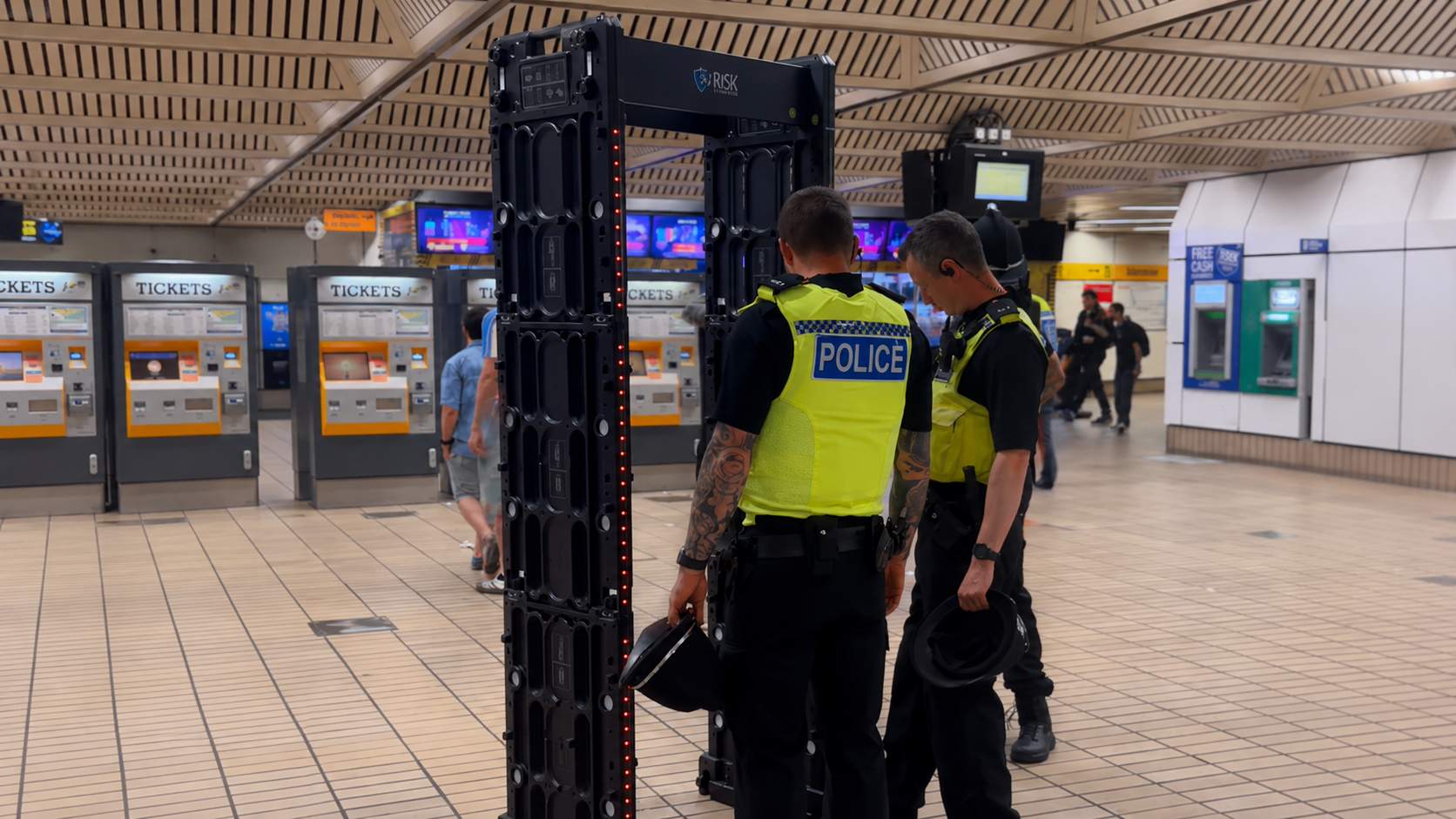
Passengers travelling through Monument Metro Station in Newcastle city centre were met by metal detectors on Wednesday, August 12, as weapon detection measures returned to one of the busiest locations on the Tyne and Wear Metro network.
The equipment, commonly known as knife arches, is designed to detect metallic objects and is regularly used by police as part of operations aimed at deterring people from carrying knives and other weapons. Their appearance can be striking for commuters, particularly when accompanied by uniformed officers, but the tactic is not new to Newcastle or the wider North East.
Why police use knife arches.
According to the College of Policing, a knife arch is a walk-through metal detector intended to identify knives and other metallic offensive weapons. Police can deploy them at transport hubs, nightlife areas and other busy locations where intelligence or patterns of offending suggest they could be useful.
The theory is relatively simple. Someone carrying a weapon faces a greater risk of detection, while the visible presence of an arch may persuade another person not to carry a knife in the first place. However, the College of Policing says evidence that knife arches themselves reduce overall knife crime is limited.
That distinction matters. The equipment can detect weapons and support arrests, but measuring crimes that never happen because someone was deterred is considerably harder.
Monument has seen metal detectors before.
This is not the first time passengers at Monument have encountered the tactic. During November 2023, Metro users reported police, staff and metal detectors at the city centre station during an anti-knife crime operation. The deployment prompted a mixed response locally, with some supporting additional precautions while others questioned whether anyone carrying a weapon could simply avoid the checks.
More recently, Northumbria Police has continued using knife arches across the region. During Operation Sceptre in May 2025, police said knife arch operations at busy areas including transport hubs resulted in engagement with around 600 people. Officers also seized 34 knives during the wider week of action, while more than 500 weapons were surrendered, including 17 zombie knives.
An earlier Operation Sceptre campaign in November 2024 saw police and Nexus conduct additional patrols on the North East transport network. Police recorded 141 stop and searches during the operation and confirmed a knife arch was used during the week.
Why knife arches remain controversial.
Criticism largely centres on effectiveness, inconvenience and police powers. In a public place, people are not automatically legally required to walk through a knife arch, according to College of Policing guidance. Triggering an arch or refusing to walk through one does not automatically provide grounds for a search when there is no supporting intelligence, although behaviour and other circumstances can contribute to reasonable suspicion.
The College also acknowledges possible unintended consequences, including offenders avoiding the location, weapons being hidden elsewhere, delays to innocent passengers and resentment if operations are considered unfair. High-footfall railway and Metro stations can make those issues particularly relevant.
National stop and search figures provide further context to the debate. In the year ending March 2025, 14.9% of stop and searches in England and Wales resulted in an arrest, while 66.8% were initially recorded as requiring no further action.
What the latest knife crime figures show.
The latest available ONS figures provide a more encouraging national picture. Police recorded 49,151 offences involving knives or sharp instruments in England and Wales during the year ending December 2025, down 10% from 54,548 a year earlier. Around 44% involved assault with injury or intent to cause serious harm, while 40% involved robbery.
Knife or sharp instrument homicides also fell 21%, from 217 to 172, while hospital admissions following assaults with sharp objects fell 10% to 3,326.
Closer to home, targeted North East initiatives have reported significant reductions in selected hotspots. Project Shield recorded a 20% fall in serious violence and a 50% reduction in knife crime in the areas it covered during the final quarter of 2024, alongside more than 8,000 additional police and partner patrol hours. These figures relate specifically to Project Shield areas rather than Newcastle or the Northumbria Police area as a whole.
For passengers passing through Monument, the debate is therefore likely to continue: whether knife arches provide a valuable visible deterrent or simply move the problem somewhere else.
Share your experiences.
Have you ever been asked to walk through a knife arch in Newcastle?
Crime News
Knife Arches Deployed at Monument Metro
Advertisement




Comments (0)
You must be logged in to post comments.
Don't have an account? Register here
No comments yet. Be the first to share your thoughts!