
Newcastle's nightlife is one of the few things about the city that is genuinely famous nationally. Stag and hen parties travel to it, television has made a running joke of it, and the Bigg Market's reputation long preceded any of that.
Behind the reputation is a substantial industry, employing thousands of people across the city and operating within a regulatory framework most customers never think about.
Here is how it works as a business.
The geography is distinct.
Newcastle's night-time economy is unusually concentrated, which is part of why it functions as it does.
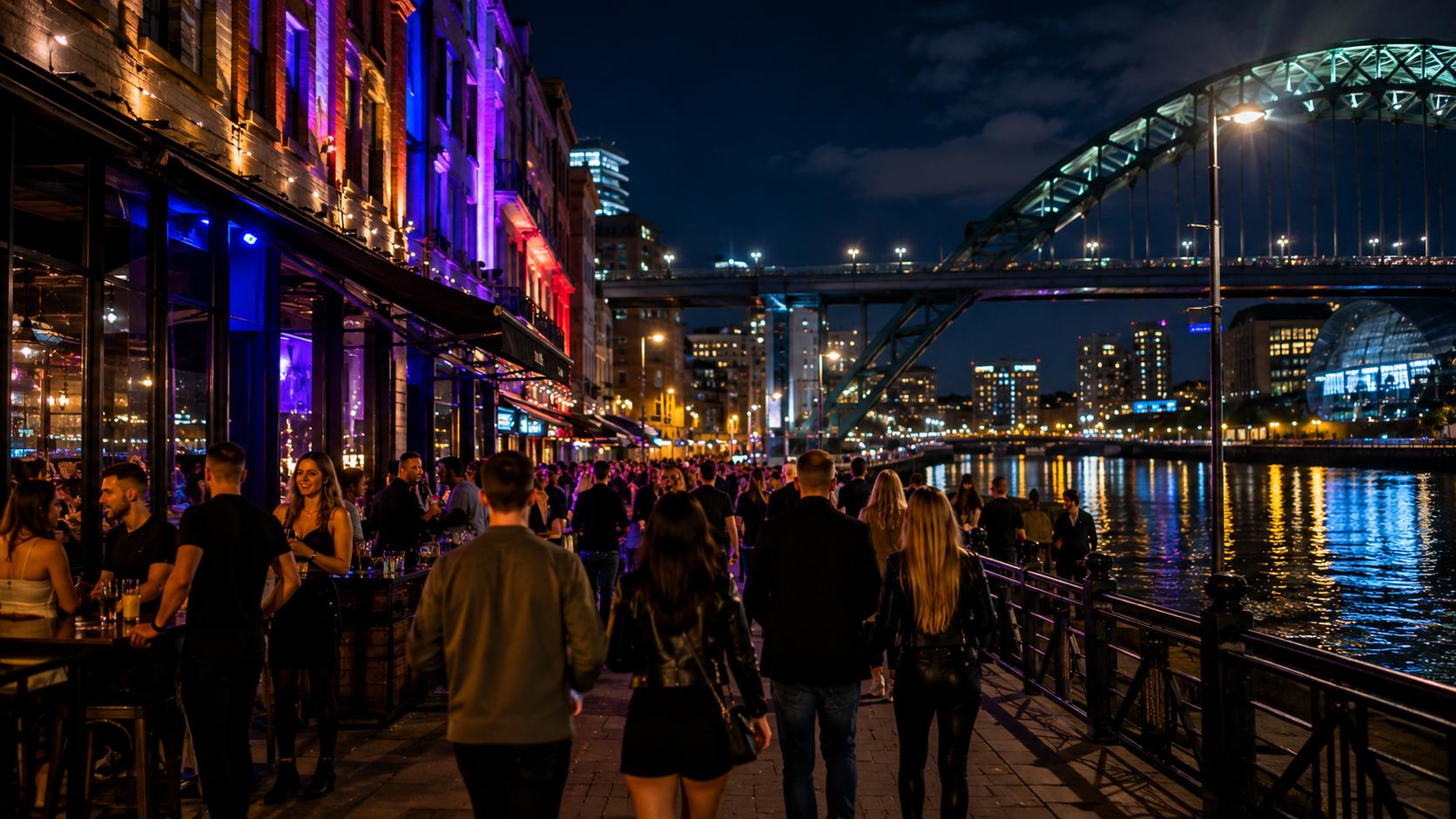
The Bigg Market is the historic centre of it, subject to significant public realm investment in recent years aimed at broadening its offer beyond late-night drinking.
The Diamond Strip around Collingwood Street developed as a higher-end cluster of bars and clubs, while the Quayside offers a riverside strip with a different customer profile again. Jesmond and Osborne Road serve a substantially student and young professional market.
That concentration means the sector can be managed, policed and transported as a defined area rather than being dispersed across a wide city.
Employment is significant and mostly local.
Hospitality is among the largest employers in Newcastle, spanning bars, restaurants, clubs, hotels, security, cleaning, taxis, food supply and events.
The workforce skews young, includes a high proportion of students, and features a substantial number of part-time and flexible roles.
That flexibility is both the sector's strength and its weakness. It provides accessible work with low entry barriers, and it produces high turnover, variable hours and, in parts of the sector, low pay.
Licensing governs almost everything.
The Licensing Act 2003 establishes the framework, with Newcastle City Council as licensing authority.
Premises licences specify permitted hours, permitted activities and conditions. Applications are consulted on, and responsible authorities including police, environmental health and fire service may make representations, as may local residents.
The Act sets four licensing objectives: prevention of crime and disorder, public safety, prevention of public nuisance and protection of children from harm. Every decision must be made by reference to those objectives rather than to general opinion about whether a venue is desirable.
Councils publish a statement of licensing policy, and may designate cumulative impact areas where the concentration of licensed premises is judged to be causing problems, creating a presumption against new licences in that area.
Safety schemes operate across the sector.
Purple Flag is a national accreditation for town and city centres meeting standards for a well-managed evening economy, covering safety, cleanliness, transport and diversity of offer.
Best Bar None accredits individual venues against standards on management, staff training and customer safety.
Newcastle operates a range of night-time safety provision including street pastors, taxi marshalling, and initiatives on drink spiking and vulnerability. Radio link schemes connect door staff across venues with each other and with CCTV operators and police.
Transport is a constraint.
Getting people home is a persistent challenge for any concentrated night-time economy.
The Metro does not run through the night on most days, though extended services have operated for specific events, which places substantial pressure on taxis and private hire at closing time.
Taxi availability, licensing and ranks are a recurring subject of discussion between operators, the council and police, since queues at dispersal are a common flashpoint.
Staggered closing times are one tool used to spread dispersal rather than emptying every venue simultaneously.
The sector faces real pressure.
Operators across the country have faced compounding cost increases: energy, food and drink supply, wages, national insurance and business rates.
Consumer behaviour has also shifted. Younger drinkers report drinking less alcohol than previous generations, and demand has grown for low and no-alcohol options and for earlier, food-led evenings.
That has pushed the sector towards a broader offer, and Newcastle's evening economy now includes considerably more restaurants, competitive socialising venues, live music and daytime-into-evening trading than it did twenty years ago.
Business rates and rent remain among the largest fixed costs, and changes to rates relief for hospitality have direct consequences for viability.
Reputation is a commercial asset and a liability.
Newcastle's nightlife reputation draws visitors and supports hotel occupancy at weekends, which is commercially valuable.
It also carries costs, including policing demand, healthcare pressure and the effect on how the city is perceived by investors and by residents who do not use the night-time economy.
Considerable effort has gone into broadening the city's evening offer precisely to address that balance, and NE1's evening economy work has been part of it.
The regulatory picture keeps moving.
Licensing conditions, cumulative impact policies and any late night levy arrangements are set locally and reviewed periodically, and operators need to track consultations that affect them.
Trade bodies including UKHospitality and the local chamber of commerce represent operators in those discussions, and Pubwatch schemes coordinate between venues on individual problem customers.
For anyone operating in the sector, engaging with the council's licensing policy consultations is considerably more effective than objecting to individual decisions afterwards.
Share your thoughts.
Has Newcastle's night out changed in the last decade, and for better or worse?
Business News
Newcastle's Night-Time Economy: The Business Behind It
Newcastle's reputation as a night out is nationally known. The sector behind it employs thousands and operates under a licensing framework few customers ever see.
Advertisement





Comments (0)
You must be logged in to post comments.
Don't have an account? Register here
No comments yet. Be the first to share your thoughts!