
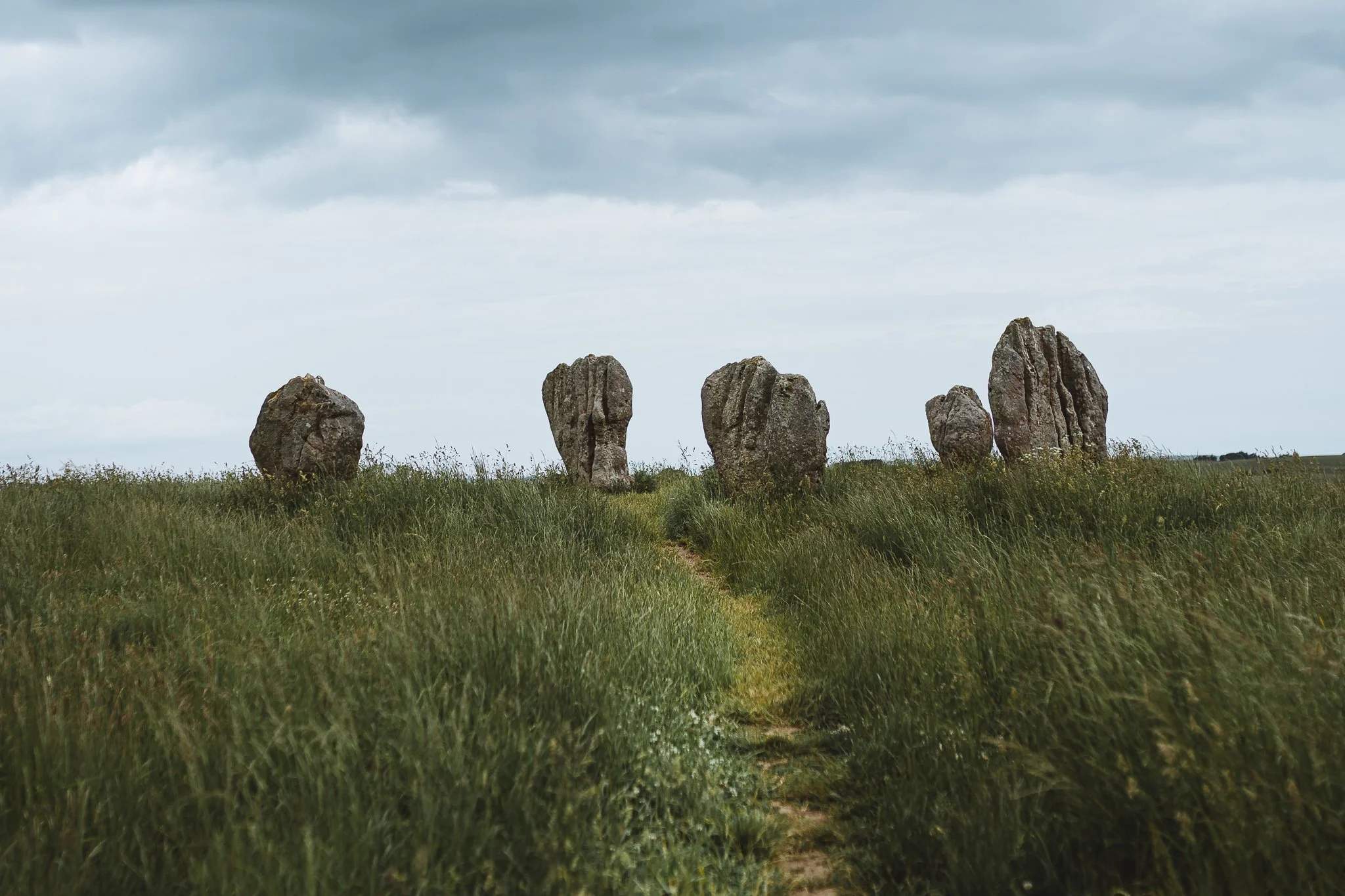
Tucked away in the rolling countryside of Northumberland sits one of the North East's most mysterious prehistoric landmarks. The Duddo Five Stones have stood watch over the landscape for around 4,000 years, surviving changing kingdoms, harsh weather and countless generations of curious visitors. Despite their age, nobody can say with certainty why they were built, making them one of the region's greatest unsolved historical puzzles.
Just over an hour's drive from Newcastle, the stones remain surprisingly unknown compared with attractions such as Hadrian's Wall or Bamburgh Castle. Their isolated location only adds to the atmosphere. A short walk through open farmland eventually reveals the weathered sandstone pillars rising from a hilltop, their unusual twisted appearance giving them an almost ghostly silhouette.
Older than many famous landmarks.
Archaeologists believe the monument dates to the late Neolithic or early Bronze Age, making it considerably older than many of Britain's medieval castles and churches. Historic England records suggest the circle originally consisted of six stones arranged in a ring around 10.5 metres across. One stone disappeared centuries ago, while another was re-erected during the early 1900s after falling, creating the five standing stones visitors see today.
Excavations uncovered charcoal and fragments of bone beneath the centre of the circle, hinting that ceremonial rituals or burials may once have taken place there. However, no definitive explanation has ever been found.
Legends continue to surround the stones.
Like many prehistoric monuments across Britain, local folklore has filled the gaps left by history. The Duddo Stones have earned nicknames including "The Singing Stones" and "The Women", with stories claiming they were once people turned to stone as punishment for breaking religious rules.
Others believe the site held astronomical importance, with standing stones across Britain often aligned to significant sunrise or sunset events during the year. While researchers continue to study these theories, there is still no universal agreement about the monument's original purpose.
The North East's prehistoric landscape.
Many people associate prehistoric Britain with Stonehenge, yet Northumberland contains an extraordinary collection of ancient sites. Academic research identifies the wider North East as home to around 135 standing stone records, 57 stone circles and hundreds of other prehistoric monuments from the Neolithic and Bronze Age periods.
The county also boasts one of Europe's richest collections of prehistoric rock art, with thousands of mysterious cup-and-ring carvings scattered across its hillsides. These ancient markings remain just as enigmatic as the standing stones themselves.
Why the mystery still attracts visitors.
Unlike many famous archaeological attractions, the Duddo Stones have avoided large-scale commercial development. There are no visitor centres or ticket booths, leaving the experience much as it would have been decades ago.
That sense of isolation continues to attract photographers, walkers and history enthusiasts searching for places that feel untouched by modern life. Northumberland itself welcomed more than 11 million visitors during 2025, highlighting the county's growing popularity as a destination for heritage and outdoor tourism.
Whether the stones marked ancient ceremonies, honoured the dead or tracked the movement of the Sun, their greatest appeal lies in the fact that nobody truly knows. Four millennia after they were raised, the Duddo Five Stones continue to keep their biggest secret hidden in plain sight.
Share your experience.
Have you visited the Duddo Five Stones or discovered another mysterious place in the North East?
Newcastle History
North East's Ancient Stones Still Defy Explanation
Advertisement



Comments (0)
You must be logged in to post comments.
Don't have an account? Register here
No comments yet. Be the first to share your thoughts!