
A growing campaign over the future of Stamfordham Road has put trees, cycling and transport policy firmly in the spotlight in Newcastle, with more than 1,600 people backing a petition opposing a proposed cycle lane.
The petition, started by Steven Rutherford, a Reform UK councillor for Denton and Westerhope, focuses on the Newbiggin Hall side of Stamfordham Road and claims that nearly 40 mature trees could be removed as part of the proposed scheme. It also raises concerns about the potential loss of existing green space and the possibility of additional areas being covered with tarmac.
As of August 2026, the petition page showed 1,680 signatures and hundreds of comments. However, while the campaign and concerns surrounding the trees are genuine, there is an important distinction between what campaigners are claiming and what can currently be confirmed through publicly available Newcastle City Council documents.
Claims over tree removals remain unsubstantiated.
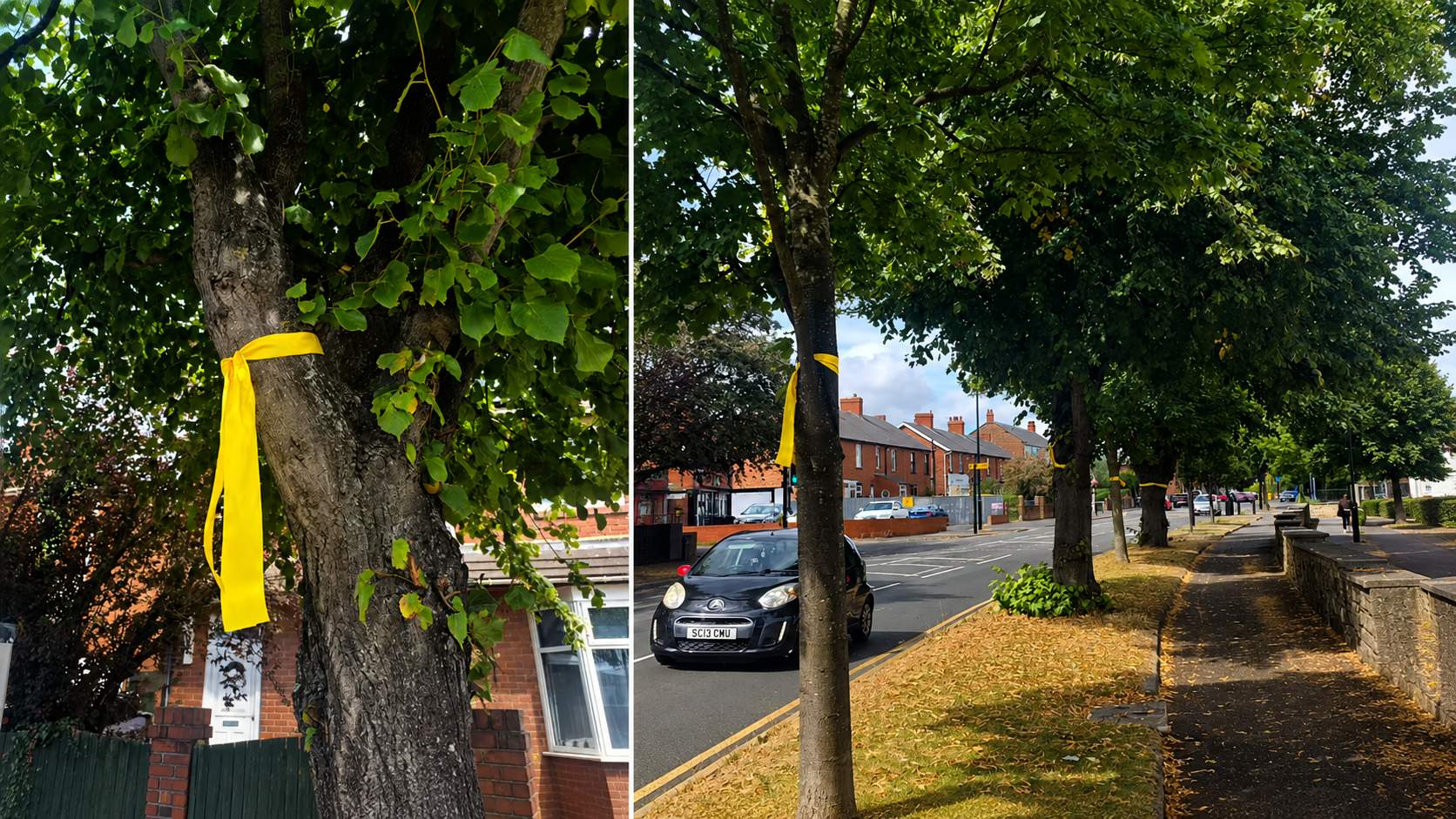
The petition states that nearly 40 mature trees would be removed if the Stamfordham Road cycle lane went ahead in its current form. Residents have also highlighted trees marked with ribbons, which campaigners say indicate those affected by the proposals.
However, a publicly available council arboricultural assessment, tree removal schedule or detailed scheme drawing confirming that approximately 40 trees are earmarked for removal has not been identified.
That means the figure should currently be attributed to campaigners rather than presented as a confirmed Newcastle City Council decision.
Reform UK party members have increasingly featured in independent political fact-checking, including disputes over immigration figures, council tax and election claims. That makes it particularly important to separate campaign rhetoric and emotive claims designed to attract attention from independently verified evidence when assessing the Stamfordham Road controversy.
The distinction is particularly important given the strength of feeling generated by the proposals. Mature roadside trees provide more than visual character, with benefits including shade, wildlife habitat, rainwater management and improvements to the urban environment.
Newcastle City Council's own Tree Policy says the city had an estimated tree canopy cover of 18.1 per cent when measured through an iTree Canopy study. The authority has set a target of increasing canopy cover to 20 per cent by 2050.
Newcastle has ambitious targets for its trees.
Council figures provide useful context for the Stamfordham Road debate. Newcastle previously estimated that reaching its 20 per cent canopy target would be equivalent to around 19,000 additional trees, alongside replacing trees lost for other reasons.
More than 31,000 trees were recorded as planted across Newcastle during one planting year covered by figures released in 2021, although the council cautioned that not every newly planted tree would survive to maturity. During 2019/20, the figures recorded 31,966 trees planted and 648 removed.
Those statistics make the Stamfordham Road controversy particularly relevant to the wider discussion about how Newcastle balances greener transport with the protection of established green infrastructure.
Removing a mature tree and planting a young replacement are also not immediately equivalent in terms of canopy, character or environmental contribution. This makes the details of any eventual mitigation or replacement planting an important part of assessing a final scheme.
Stamfordham Road is part of wider transport plans.
There is no doubt that Stamfordham Road features in Newcastle's wider transport programme.
Newcastle City Council identifies Central Motorway East and Stamfordham Road as one of four major corridors included in its Bus Service Improvement Plan. The regional programme is backed by £163.5 million of government funding and includes measures designed to improve bus reliability while increasing safety for pedestrians and cyclists.
However, the council's current public Improving Travel page does not separately list a Stamfordham Road cycle lane scheme among its named infrastructure projects.
This leaves an important gap between the detailed claims being made by opponents and the information currently easy to locate through the council's public-facing transport pages.
Greater publication of the proposed layout, affected trees, design alternatives and environmental assessment would allow Newcastle residents to judge the scheme on the evidence rather than competing claims.
Cycling remains part of Newcastle's long-term strategy.
The controversy also comes as Newcastle pursues a broader transformation of transport across the city.
The Newcastle Movement Strategy, adopted in September 2025, will guide transport development until 2045. Among its aims are making it safer and easier for people to walk, wheel, cycle and use public transport.
Public consultation demonstrated considerable support for the strategy's overall direction. More than 1,300 people and organisations participated, with almost 80 per cent of respondents agreeing with its proposed vision. Residents identified public transport, road safety and accessibility as major priorities, while better air quality, congestion and walking and wheeling also featured in the feedback.
That creates a difficult but important policy question. Newcastle wants more sustainable transport while simultaneously seeking to protect and expand its urban tree canopy. The two objectives do not necessarily conflict, but individual schemes can force difficult choices about road space, established trees and neighbourhood character.
Petition puts pressure on Newcastle decision-makers.
Campaigners are now hoping the scale of the Stamfordham Road petition will encourage decision-makers to reconsider the proposals or explore alternative designs.
What remains missing from the public debate is definitive documentation confirming exactly how many trees would be affected, their condition and species, whether every identified tree would require removal, and what alternatives have been considered.
Until those details are published, claims that nearly 40 mature trees will definitely disappear should be treated as allegations made by opponents of the scheme rather than an established outcome.
With 1,680 signatures already recorded, however, the strength of local concern is difficult to overlook.
For Newcastle, the Stamfordham Road dispute could become a significant test of whether new active travel infrastructure and the city's established green landscape can successfully coexist.
Have your say.
What do you think about the Stamfordham Road plans?
Local News
Reform Councillor's Stamfordham Road Petition Claims Unverified
Advertisement



Comments (0)
You must be logged in to post comments.
Don't have an account? Register here
No comments yet. Be the first to share your thoughts!