
For more than a century the River Tyne rang with the sound of the shipyards, and no name better captures the glory of that great industry than Swan Hunter. From its yards at Wallsend came some of the most famous ships ever built, including the legendary liner that held the record for crossing the Atlantic for over twenty years. The story of Swan Hunter is the story of Tyneside shipbuilding itself, an industry that made the North East famous across the world and gave the region a proud identity built on skill and craftsmanship.
The Birth of a Great Firm.
Swan Hunter took shape in 1880, when George Burton Hunter formed a partnership with the widow of Charles Sheridan Swan, whose Wallsend shipbuilding business had roots stretching back several decades. Hunter was a fair and capable employer who built the firm steadily under boom conditions, and the yard grew rapidly. In 1903 the company merged with another Tyneside shipbuilder, Wigham Richardson, specifically in order to bid for a prestigious contract from the Cunard Line. The bid was successful, and the enlarged firm, one of the largest shipbuilders in the world, set about building what would become its most celebrated vessel.
The Mighty Mauretania.
The ship was the Mauretania, launched from Wallsend in 1906 to the cheers of vast crowds, and she became in her day the most famous ocean liner in the world. Powered by advanced turbine engines built on the Tyne, she captured the Blue Riband for the fastest crossing of the Atlantic and held that record for more than two decades, an extraordinary achievement that brought enormous prestige to the yard and to the region. The Mauretania was a marvel of engineering and a symbol of British maritime supremacy, and she carried the name of Tyneside around the globe.
A Yard of Famous Ships.
The Mauretania was the most celebrated of Swan Hunter's creations, but it was far from the only one. Over its long history the firm built around sixteen hundred ships of every kind, from passenger liners and cargo vessels to warships and enormous supertankers. Among them was the Carpathia, the ship that came to the rescue of the survivors of the Titanic, and later great warships including aircraft carriers. The yard could build vessels of almost any type and size, and its order books reflected the central role that Tyneside played in supplying the ships that sailed the world's oceans.
The Heart of an Industry.
Swan Hunter was just one part, albeit a glorious one, of a shipbuilding industry that lined both banks of the Tyne and employed many thousands of people. Whole communities grew up around the yards, with skills passed down through generations and a fierce pride in the work. The launch of a great ship was a moment of celebration that brought crowds to the riverside, and the industry shaped the identity of towns such as Wallsend, Jarrow and Hebburn. To build ships on the Tyne was to be part of something that connected the North East to every corner of the globe.
Skill and Pride.
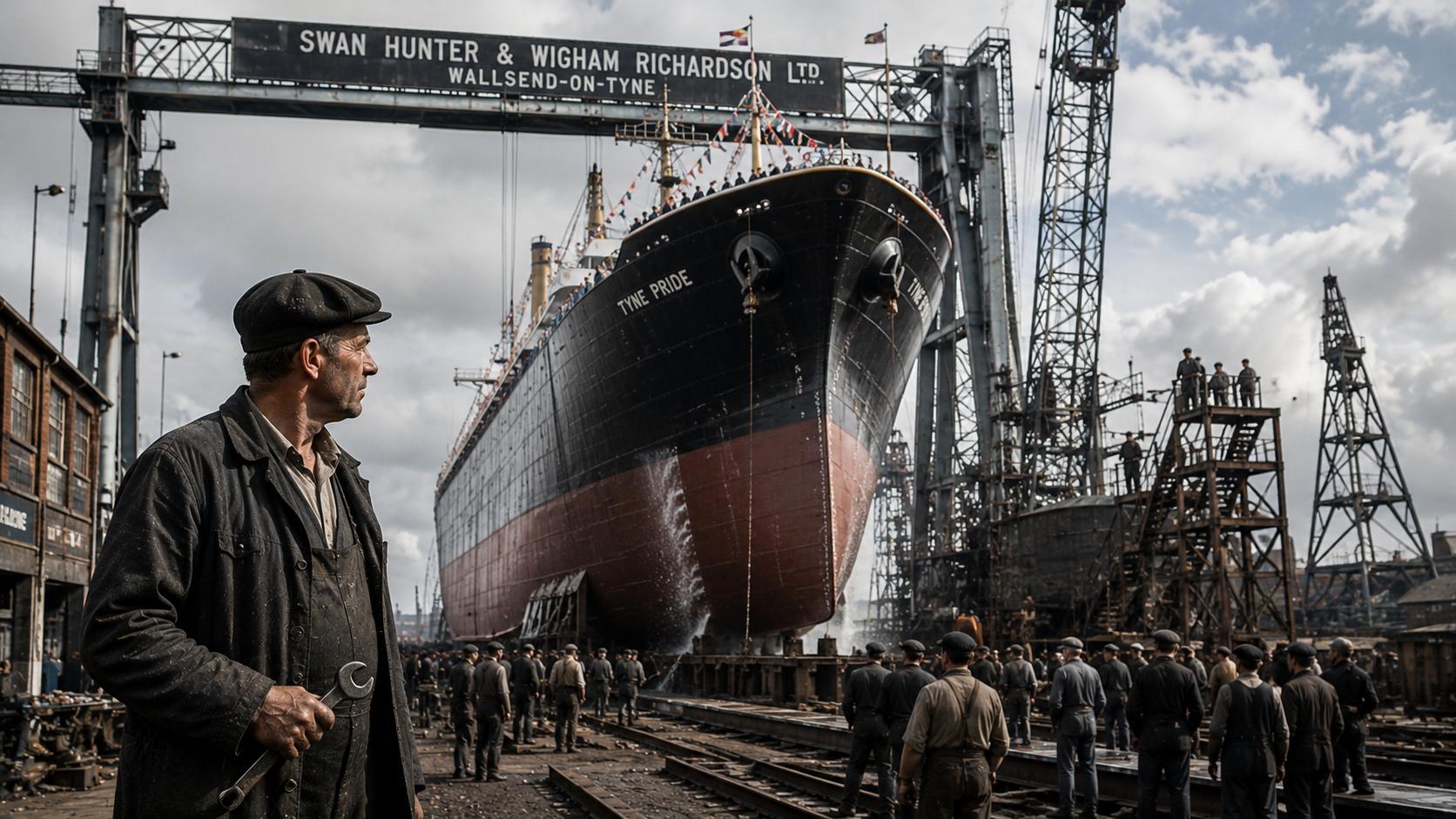
The reputation of Tyneside shipbuilding rested on the skill of its workforce. The riveters, platers, welders, joiners and engineers who built the ships were craftsmen of the highest order, and their expertise was respected throughout the maritime world. The work was hard and often dangerous, carried out in all weathers on the open river, but it was also a source of deep pride. The ships that slid down the slipways were the product of countless hours of demanding labour, and the men who built them knew that their work would sail the seas for decades to come.
Decline and Memory.
Like the other great heavy industries of the North East, shipbuilding on the Tyne eventually declined in the face of changing economics and competition from abroad. Swan Hunter ceased building ships on Tyneside in 2006, bringing to an end a chapter that had lasted well over a century. The closure was keenly felt in a region for which shipbuilding had been so central to its sense of itself. Yet the memory of the industry remains powerful, preserved in museums, in family stories and in the very landscape of the river that was once crowded with yards.
A Proud Legacy.
The legacy of Swan Hunter and of Tyneside shipbuilding endures far beyond the closure of the yards. The ships built on the Tyne sailed the world and shaped maritime history, and the skills and pride of the workforce became part of the enduring character of the North East. When people speak of the region's industrial heritage, the image of a great ship taking shape on the river is among the most powerful of all. Swan Hunter stands as a monument to an age when the North East built some of the finest ships in the world and did so with unmatched skill and pride.
The Day a Ship Was Launched.
For the communities of the Tyne, the launch of a great ship was one of the most thrilling events imaginable. Crowds would gather along the riverbank in their thousands to watch as a vast hull, the product of months or years of labour, slid down the slipway and met the water for the first time.
There was drama and spectacle in the moment, the towering ship in motion, the splash and surge as it entered the river, the cheers of the onlookers and the pride of the workers who had built it. These launches were communal celebrations that brought whole towns together, marking the culmination of an enormous collective effort.
They were also reminders of the global reach of Tyneside's work, for the ships that were launched would go on to sail the oceans of the world, carrying cargo and passengers between distant ports or serving in the navies of many nations. In an age before mass entertainment, a ship launch was an event to be remembered and talked about, and it bound the people of the river ever more closely to the great industry that defined their lives.
The memory of those launches remains a cherished part of the region's heritage.
Get involved.
What does the heritage of Tyneside shipbuilding mean to you and your family?
Business News
Swan Hunter and the Glory of Tyneside Shipbuilding
The story of Swan Hunter of Wallsend, builders of the record-breaking liner Mauretania, and the Tyneside shipbuilding industry that made the region famous.
Advertisement




Comments (0)
You must be logged in to post comments.
Don't have an account? Register here
No comments yet. Be the first to share your thoughts!