
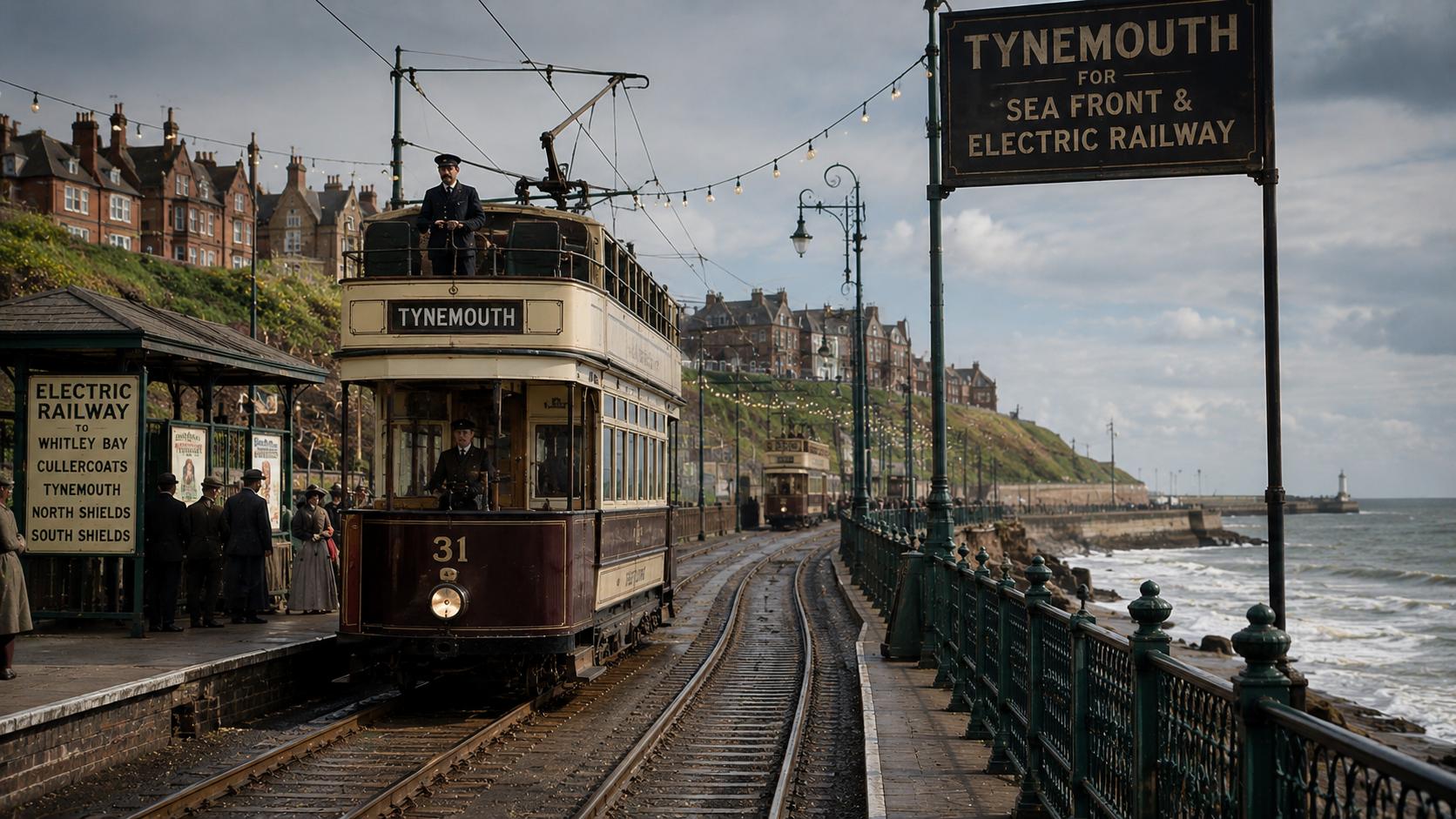
Long before the modern Metro carried passengers around Tyneside, the railways of the region were already among the most advanced in the country. In the early years of the twentieth century, the line linking Newcastle with the coast became one of the first electric suburban railways in Britain, a pioneering system that brought the benefits of electric traction to ordinary travellers decades ahead of much of the rest of the nation. It was another example of the North East leading the way.
The Challenge of Competition.
At the turn of the twentieth century, the railway companies faced a new and growing rival. Electric trams were spreading through the towns and cities, offering frequent, cheap and convenient travel that drew passengers away from the steam-hauled local trains. On Tyneside, where the railway carried large numbers of commuters between Newcastle and the coastal towns, this competition was keenly felt. The railway needed to respond, and the answer it chose was bold: to electrify its busy suburban lines and offer a modern service that could match and surpass the trams.
Electrifying the Lines.
In the early years of the century, the railway company electrified its Tyneside coast lines, introducing electric trains in place of the old steam services. This was a pioneering step, for the electrification of suburban railways was still in its infancy, and Tyneside was among the very first places in Britain to adopt it on this scale. The new system used an electrified rail to power the trains, and it was advised upon by the same North East engineers who were leading the region's wider electrical revolution. The line became a showcase for the practical application of electric power to everyday transport.
A Better Way to Travel.
The new electric trains offered a great improvement for passengers. They were faster, cleaner and more frequent than the steam services they replaced, accelerating quickly between the closely spaced suburban stations and providing the kind of regular, reliable service that commuters valued. Free from the smoke and grime of steam, the electric trains made the journey between Newcastle and the coast far more pleasant. The improved service won back passengers from the trams and proved the value of electrification, demonstrating that the new technology could transform the experience of everyday travel.
Serving the Coast.
The electrified line served the popular route between Newcastle and the coastal towns, carrying not only daily commuters but also the crowds heading for the seaside. In an age when a trip to the coast was a cherished outing, the electric trains brought the beaches and attractions of the coast within easy reach of the people of Tyneside. The line became an essential part of life in the region, linking the city with the sea and supporting the growth of the coastal communities. It was woven into the rhythms of work and leisure across the area.
A Glimpse of the Future.
The Tyneside electric railway was, in a very real sense, a glimpse of the future of public transport. At a time when most of the country still relied on steam, the region was demonstrating the advantages of electric traction for busy passenger lines. The principles proven on Tyneside, of fast, frequent, electric suburban services, would in time be adopted across the country and the world. The North East had shown what was possible, and its early adoption of electric railways was a mark of the technological confidence and ambition that characterised the region in its great age.
The Ancestor of the Metro.
The pioneering electric railway has a direct connection to the modern Metro that serves Tyneside today. Much of the network on which the early electric trains ran was later incorporated into the Metro system, so that the lines first electrified in the early twentieth century continue to carry passengers in the twenty-first. In this way, the modern Metro can trace part of its ancestry back to those early electric services, and the vision of fast electric travel around Tyneside that was pioneered so long ago lives on in the railway that the region relies on now.
A Pioneering Heritage.
The story of Tyneside's early electric railway is another chapter in the region's remarkable history of technological leadership. From the friction match to the electric grid, and from the lifeboat to the great telescopes, the North East has again and again been at the forefront of innovation, and its pioneering electric trains belong firmly in that tradition. That the region brought modern electric travel to its people so early is a source of pride and a reminder that, in the great age of invention, Tyneside was very often ahead of the rest. The electric coast was a glimpse of the world to come.
A Region That Looked Ahead.
The early electrification of the Tyneside railways is part of a broader pattern that runs through the history of the North East: a willingness to embrace new technology and to look ahead rather than cling to the familiar.
Time and again, the region was among the first to adopt and develop the innovations that would shape the future, from the steam locomotive to electric power and beyond. The decision to electrify the coast lines so early, when steam still ruled the railways almost everywhere else, was characteristic of this forward-looking spirit, a confidence that the new technology represented the future and that the region should lead rather than follow.
This readiness to innovate was one of the great strengths of the North East in its age of industrial and technological leadership, and it produced a remarkable concentration of pioneering achievement. The electric trains that ran between Newcastle and the coast were a tangible expression of this spirit, bringing the benefits of modern technology to the everyday lives of ordinary people well ahead of their time.
That the same forward-looking ambition has continued into later eras, producing the modern Metro and the region's ongoing embrace of new transport technology, shows how deeply this characteristic is woven into the identity of the North East.
The story of the early electric railway is a reminder that the region has long understood the value of looking ahead and of being willing to lead the way into the future.
Over to you.
Did you know that the Metro's lines carried electric trains over a century ago?
Tech News
The Electric Coast: Tyneside's Pioneering Electric Railway
How the railway between Newcastle and the coast became one of Britain's first electric suburban railways in 1904, a forerunner of the Tyne and Wear Metro.
Advertisement




Comments (0)
You must be logged in to post comments.
Don't have an account? Register here
No comments yet. Be the first to share your thoughts!