
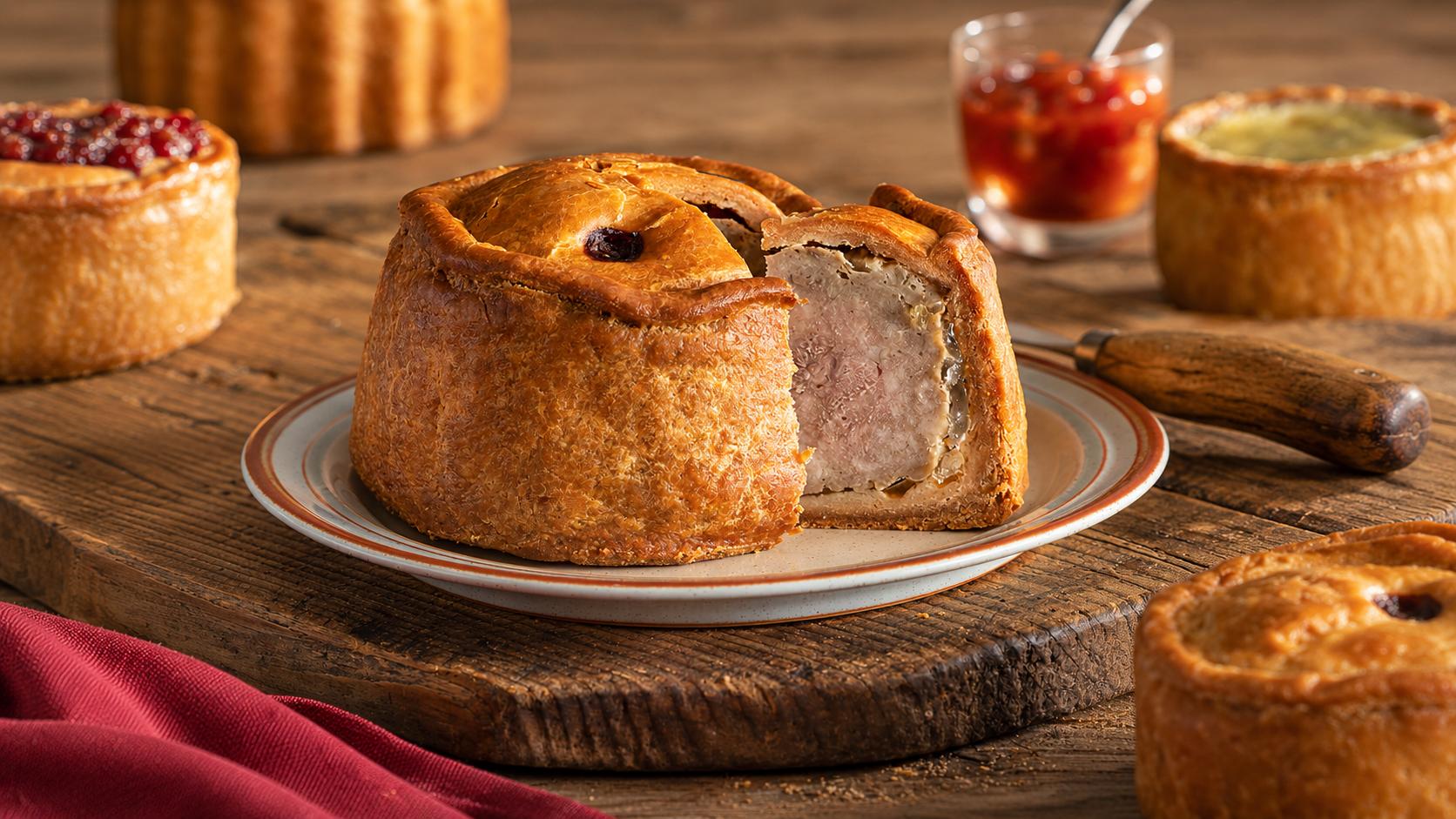
Describe a Melton Mowbray pork pie to someone who has never encountered one and it does not sound promising. Grey meat, a layer of savoury jelly, and sides that bulge outward rather than standing straight.
Yet it is one of only a small number of British foods to hold protected status, and the details that sound like faults are precisely the features that define it.
Here is the story of Britain's other protected pie.
Leicestershire dairy country created it.
Melton Mowbray sits in the heart of a dairy region long associated with Stilton cheese, another protected product made nearby.
Cheesemaking produces whey as a by-product, and whey was traditionally fed to pigs. Where there is a dairy industry, in other words, there tends to be a pork industry alongside it.
Pork pies emerged as a practical way of using that pork, and as portable food that kept reasonably well. They were being sold commercially in Melton Mowbray by the late eighteenth century.
Fox hunting spread its reputation.
Leicestershire was the centre of English fox hunting, and the season brought wealthy visitors from across the country to the area around Melton Mowbray.
Pork pies were ideal food for a day in the field: robust, self-contained and requiring no cutlery. Hunt followers carried them in coat pockets.
Those visitors took the taste home with them, and demand spread. The arrival of the railways allowed pies to be sent to London and beyond, turning a local product into a national one during the nineteenth century.
The shape comes from the method.
A genuine Melton Mowbray pie is hand raised, meaning the hot water crust pastry is moulded by hand around a wooden former rather than baked in a tin.
The pie is then baked free-standing, without support. As it cooks, the sides bow outward under the weight of the filling, producing the characteristic irregular, bulging profile.
Pies baked in a hoop or tin have straight sides. The difference is immediately visible and is one of the clearest markers of the genuine article.
Hot water crust pastry, made with lard and boiling water, is unusual in being pliable when warm and firm when cool, which is exactly what hand raising requires.
The grey meat is the point.
The filling is uncured pork, chopped rather than minced, seasoned simply with salt and pepper.
Because the pork is uncured, it cooks to a natural greyish colour rather than the pink of cured meat. Many mass-produced pork pies use cured pork, which stays pink and looks more appealing on a shelf.
Anyone expecting pink filling often assumes a Melton Mowbray pie is undercooked or somehow wrong. It is the opposite: the grey indicates the meat has not been cured.
The jelly is not an afterthought.
During baking, the filling shrinks away from the pastry, leaving a gap. Hot stock, made from pork bones and naturally rich in gelatine, is poured in through a hole in the lid once the pie has cooled slightly.
As it sets, the jelly fills the void, excludes air and helps preserve the pie. It also keeps the filling moist.
Opinions on the jelly are divided, and a proportion of eaters remove it. Its function, however, is structural rather than decorative.
Protected status arrived in 2008.
After a lengthy application process, the Melton Mowbray pork pie was granted Protected Geographical Indication status in 2008.
That means only pies made within a defined area around the town, using uncured pork, hand raised and baked free-standing, may use the name.
The application was contested by some large manufacturers, and the process took years. It placed the pie alongside Cornish pasties, Stilton cheese and a small number of other British foods with legal protection of their name.
Following the UK's departure from the European Union, protected food names are administered through a domestic scheme, with existing designations carried across.
Where to find the real thing.
Dickinson and Morris in Melton Mowbray operates from a shop that has been baking pies on the site since the early nineteenth century and is generally regarded as the oldest surviving bakery of its kind in the town.
Several other producers within the protected area make pies to the required standard, and they are widely available in good delicatessens and farm shops.
A genuine pie is best eaten cold, traditionally with piccalilli, English mustard or a sharp chutney, and it appears on ploughman's plates and picnic tables across the country.
The wider pork pie family.
Britain produces many regional pork pies that are not Melton Mowbray pies and make no claim to be. Straight-sided pies baked in tins, cured-meat pies and pies with additional ingredients all have their followers.
The gala pie, with a boiled egg running through the centre, is a picnic staple achieved commercially by using specially elongated egg cylinders.
None of this diminishes the original. It simply means that, as with pasties and cheese, the protected name identifies one specific thing rather than a whole category.
Share your thoughts.
Do you eat the jelly, or is it the first thing to go?
Food & Drink News
Melton Mowbray Pork Pie: Britain's Other Protected Pie
A pie with bulging sides, grey meat and a layer of jelly sounds unappealing described that way, yet it holds legal protection across Europe.
Advertisement

Comments (0)
You must be logged in to post comments.
Don't have an account? Register here
No comments yet. Be the first to share your thoughts!