
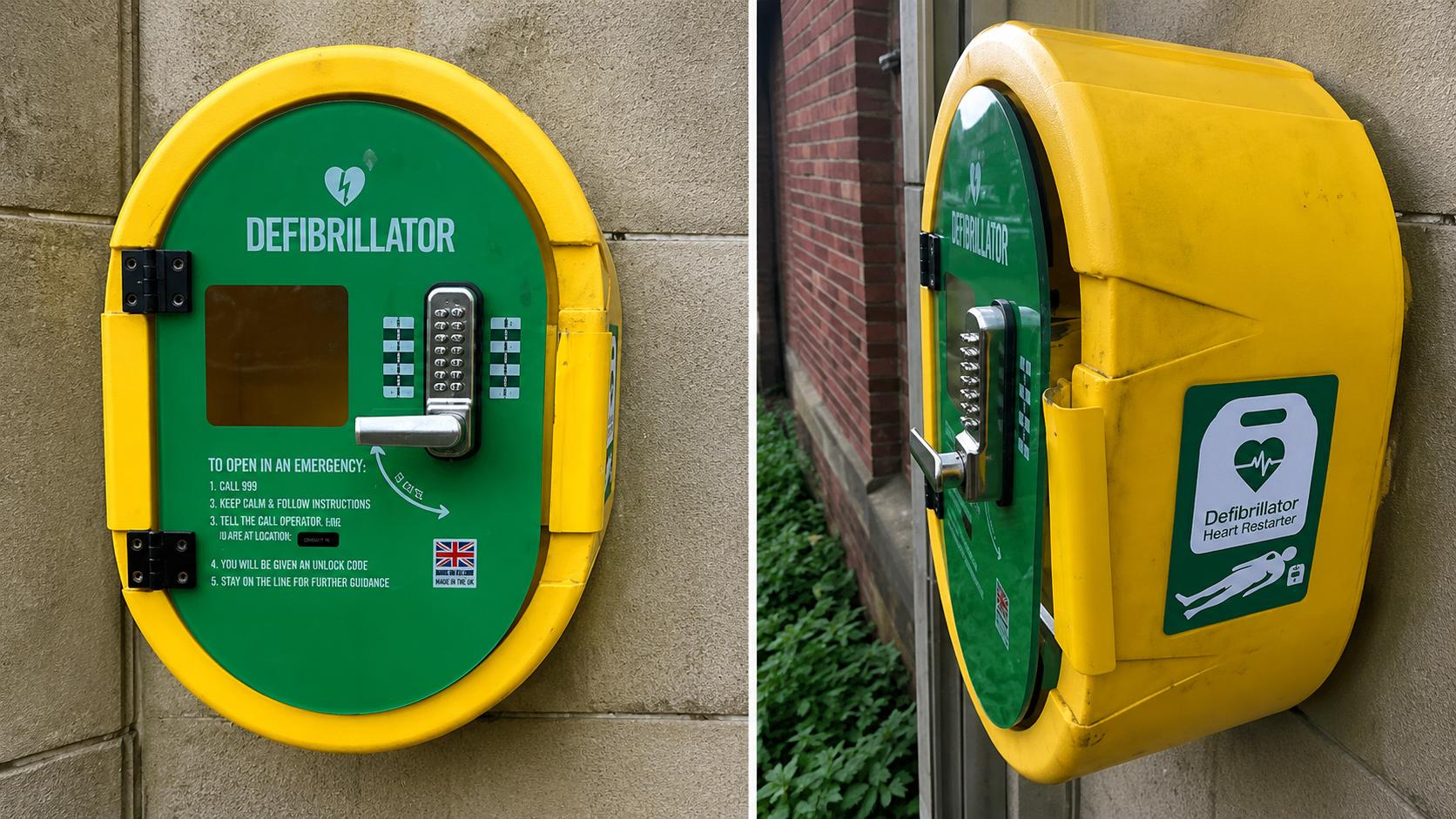
There is a yellow or green box on the wall of a good number of Newcastle buildings, and most people who walk past it every day have never given it a second look. Inside is a device that is the single most effective intervention available to a bystander when someone's heart stops.
Survival from an out-of-hospital cardiac arrest in the UK is poor, at somewhere around one in ten. Where a defibrillator is used quickly alongside effective chest compressions, survival rises dramatically. The equipment is already there. The problem is almost entirely that people do not know how to find it or believe they are not qualified to touch it.
Cardiac arrest is not a heart attack.
The two are routinely confused and are different events requiring different responses.
A heart attack occurs when blood supply to part of the heart muscle is blocked. The person is usually conscious, often in pain, and needs an ambulance urgently.
A cardiac arrest is an electrical failure in which the heart stops pumping effectively. The person collapses, becomes unresponsive and stops breathing normally. They will die within minutes without intervention.
A heart attack can cause a cardiac arrest, which is part of why the terms get tangled, but the immediate response differs entirely.
What to do, in order.
Check for danger, then check for a response. If the person is unresponsive and not breathing normally, call 999 immediately and put the phone on speaker.
Start chest compressions in the centre of the chest, pushing hard and fast, at a rate of around one hundred to one hundred and twenty per minute and to a depth of about five to six centimetres in an adult. The rhythm of Nellie the Elephant or Stayin' Alive is the traditional guide and works.
If someone else is present, send them for the nearest defibrillator while you continue compressions. If you are alone, the 999 call handler will advise; continuous compressions are generally the priority.
Compression-only resuscitation is entirely acceptable for bystanders who are untrained or unwilling to give rescue breaths, and is the approach now recommended in most bystander situations.
The 999 call handler will tell you where the defibrillator is.
This is the part most people do not know. When you call 999, the ambulance service can access a national database of registered defibrillators, and the call handler will direct you to the nearest one and give you the access code if the cabinet is locked.
That database is called The Circuit, and it is why registering a defibrillator matters as much as installing one. An unregistered device might as well not exist, because nobody will be sent to it.
Some cabinets are unlocked and can simply be opened. Others are locked with a keypad, and the code comes from the call handler.
You cannot get it wrong.
The most common reason bystanders hesitate is fear of causing harm, and it is worth stating plainly that this fear is unfounded.
A public access defibrillator analyses the person's heart rhythm and will only deliver a shock if a shockable rhythm is present. If a shock is not appropriate, the machine will not allow one to be given, no matter what buttons are pressed.
The device talks the user through every step out loud, in plain language, from where to place the pads to when to stand clear. Pictures on the pads show where they go. No training is required to use one, and the instructions are designed for people who have never seen one before.
The person is already in cardiac arrest. Without intervention they will die. There is no realistic way to make that worse.
Practical points that matter.
Remove or cut clothing to place the pads directly on bare skin. Wipe the chest if it is wet. Excessive chest hair may need to be shaved with the razor included in many kits, or a second set of pads used to strip hair.
Do not place a pad directly over an implanted pacemaker, visible as a lump under the skin, or over a medication patch; place it a few centimetres away.
Nobody should be touching the person when a shock is delivered. The device will say so clearly.
Continue chest compressions immediately after any shock, and keep going until the ambulance arrives or the person shows clear signs of life.
Where they are in Newcastle.
Defibrillators are found in shopping centres, supermarkets, gyms, leisure centres, universities, schools, transport hubs, sports grounds, workplaces, community centres, some pubs, and increasingly in converted telephone boxes taken on by community groups.
Various apps and websites map registered devices, and it is worth taking two minutes to find out where the nearest one to your home, your workplace and your regular routes is. That knowledge is only useful if it is acquired in advance.
Community groups can and do fund and install them. Ambulance services and heart charities provide guidance on siting, cabinets, registration and maintenance, and grants are frequently available.
Maintenance is not optional.
A defibrillator requires periodic checks of the battery and pads, both of which have expiry dates. A guardian is normally nominated to carry out checks and to report status.
Vandalism and theft do occur and are treated seriously precisely because of the consequences. A missing or dead defibrillator is a life lost that need not have been.
Learn the basics.
Free and low-cost training is widely available through heart charities, first aid organisations and community schemes, and takes a couple of hours. Schools across England now teach basic life support as part of the curriculum.
Even without training, the sequence above is enough. Call 999, push hard and fast on the chest, and send someone for the defibrillator.
This article is general information. In an emergency, always call 999 and follow the instructions of the call handler.
Share your thoughts.
Do you know where the nearest defibrillator to your home or workplace is?
Health News
Newcastle's Public Defibrillators: Where They Are and How to Use One
Advertisement




Comments (0)
You must be logged in to post comments.
Don't have an account? Register here
No comments yet. Be the first to share your thoughts!