
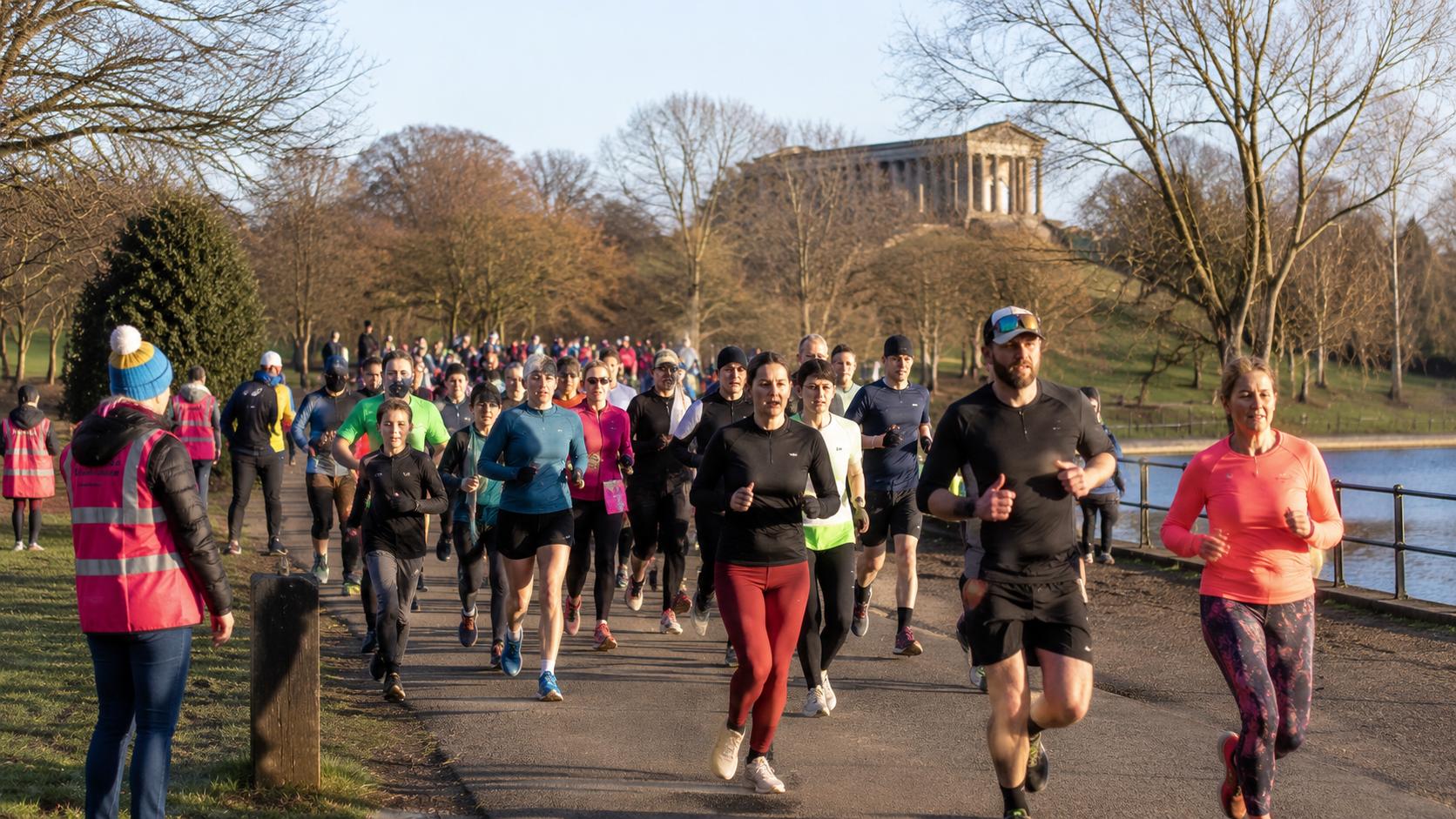
Every Saturday morning, in parks across the North East, several thousand people gather to cover five kilometres.
Nobody pays. Nobody is paid. There are no medals, no prizes and, officially, no race.
Parkrun has become one of the most successful participation initiatives in British sporting history, and its growth has been almost entirely organic.
Here is how it works and why it took hold.
It started with thirteen people.
The first event took place in 2004 at Bushy Park in Teddington, west London, organised by Paul Sinton-Hewitt while he was recovering from injury and out of work.
Thirteen runners took part, timed with a stopwatch and recorded by hand. It was originally called the Bushy Park Time Trial.
The concept spread by word of mouth as participants moved elsewhere and set up their own events. Growth accelerated through the 2010s, and there are now events across the UK and in numerous countries worldwide.
The format never changes.
Every event is five kilometres, free to enter, weekly, and organised entirely by volunteers.
Participants register once online and print or download a personal barcode, which is scanned at the finish. That barcode works at any event anywhere in the world, which is why participants collect venues while travelling.
Results are published the same day, with age-graded scores allowing comparison across different ages and sexes, and personal bests recorded automatically.
Junior parkrun runs separately on Sunday mornings over two kilometres for children aged four to fourteen.
It is emphatically not a race.
This is the point organisers repeat most often, and it matters.
Parkrun is deliberately positioned as an event rather than a competition. Walking is entirely acceptable, and a substantial proportion of participants at most events walk some or all of the course.
The tail walker, a volunteer who walks at the back and ensures nobody finishes last, is a defining feature. Nobody is left behind, and the course does not close until everyone is home.
That inclusivity is the single biggest reason for the growth. People who would never enter a running club or a timed race will turn up to something explicitly designed not to intimidate them.
Volunteering is the engine.
No event happens without volunteers, and most participants take a turn at some point.
Roles include marshalling, timekeeping, barcode scanning, setting up the course, providing first aid and, importantly, the volunteer who stands at the finish and applauds.
Volunteering counts towards recognition milestones in the same way running does, which is deliberate. The organisation treats the two as equally valuable.
For many people, particularly those unable to run, volunteering is how they participate.
The North East is well served.
Events run across Newcastle, Gateshead, Sunderland, Durham, Northumberland and Teesside, in parks, along coastlines and around country estates.
Course character varies considerably. Some are flat and fast, others involve genuine hills, and coastal events can be exposed in winter.
Attendances at the larger events regularly run into several hundred, and the region's events have grown steadily since the first arrived.
The health case is well documented.
Research into parkrun participation has consistently found benefits beyond physical fitness, particularly around mental health and social connection.
The NHS has recognised this through social prescribing, with practices able to refer patients to local events, and a substantial number of GP surgeries have registered as parkrun practices.
Participants frequently report that the social element matters more than the exercise. The coffee afterwards is not incidental to the event, it is arguably the point.
It draws all levels.
Serious club runners use it as a hard weekly effort or a tempo session, and course records at some events are genuinely quick.
At the other end, people take an hour or more, walking with children, dogs or friends, and are applauded across the line by whoever is still there.
That range in a single event is unusual in any sport, and maintaining it requires the organisation to resist pressure to make things more competitive, which it has done consistently.
Milestones give people something to aim at.
Participants receive recognition at set numbers of runs and volunteer occasions, with milestone T-shirts available at various points.
The system is deliberately based on turning up rather than on speed, which reinforces the central message that consistency matters more than pace.
For a great many participants, working towards a milestone has been what turned an occasional Saturday into a habit that lasted years.
Getting started is easy.
Register once online, print the barcode, and turn up. There is no need to book, no fee and no requirement to tell anyone you are coming.
First-timers are given a short briefing before the start, and most events have a volunteer specifically looking after newcomers.
The most common feedback from people who have gone once is that they wish they had gone sooner, and that nobody was watching or judging them in the way they had feared.
Share your thoughts.
Which North East parkrun course would you recommend to a beginner?
Sports News
Parkrun and the North East's Saturday Morning Habit
Thousands of people across the region get up on a Saturday morning to run, jog or walk five kilometres for free, and the reasons have little to do with times.
Advertisement


Comments (0)
You must be logged in to post comments.
Don't have an account? Register here
No comments yet. Be the first to share your thoughts!