
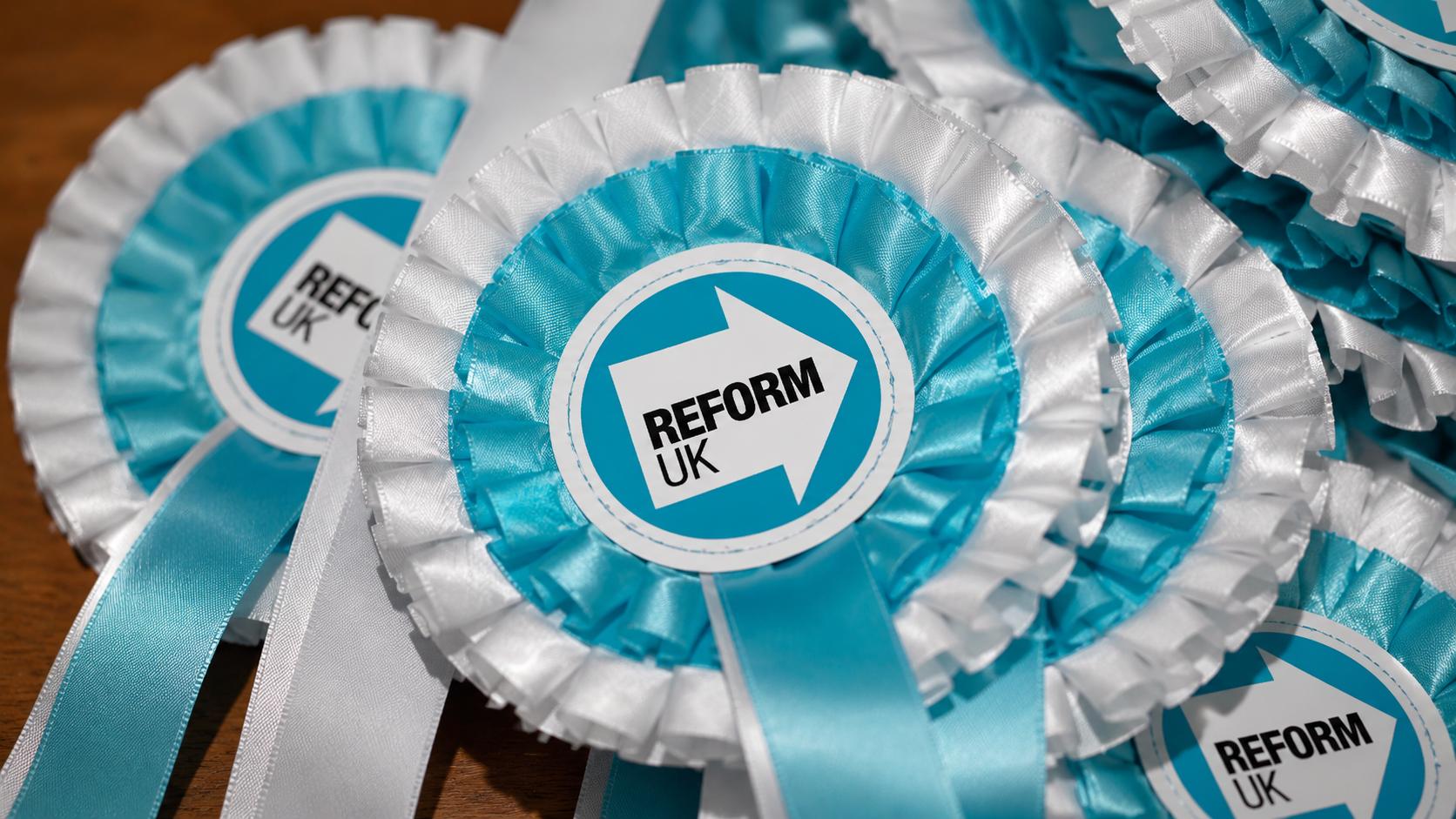
Reform UK has led or been close to leading national voting intention polls for much of the period since early 2025.
This article sets out the figures recording that rise, the survey evidence on where the party's support has come from, and how its position has changed over recent months.
The polling trajectory.
Reform UK took the lead in national polling averages around May 2025 and held it for an extended period.
The party's support peaked at approximately 34 per cent in September 2025 according to one tracker. It has declined from that high point across subsequent months.
By April 2026, one pollster recorded Reform on 25 per cent, described at the time as its lowest share since the 2024 general election. A poll published on 7 July 2026 placed the party on 24 per cent, its lowest with that pollster since January 2025.
A seven-poll average published on 24 July 2026 put Reform on 24.7 per cent, narrowly ahead of Labour on 23.1 per cent.
Local election performance.
In the May 2025 local elections in England, Reform UK won 677 council seats and took control of ten local authorities.
The May 2026 local elections produced further gains. In the North East, the party took control of Sunderland City Council.
In Newcastle, contesting all 78 seats at an all-out election, Reform UK won 24 seats with 58,925 votes and a 24.21 per cent vote share, entering the council for the first time.
Where the support has come from.
Survey work comparing current voting intention with recorded 2024 general election votes gives an indication of movement between parties.
One such survey found that 27 per cent of people who voted Conservative in 2024 intended to vote Reform, while 66 per cent remained with the Conservatives.
Among 2024 Labour voters, 15 per cent intended to vote Reform, with 60 per cent remaining loyal, 12 per cent moving to the Liberal Democrats and 9 per cent to the Greens.
Reform UK's support therefore draws from both former major parties, though in different proportions.
The referendum split remains visible.
The same survey examined voting intention by how respondents voted in the 2016 EU referendum.
Among those who voted Leave, 53 per cent intended to vote Reform, 24 per cent Conservative, 8 per cent Labour, 8 per cent Liberal Democrat and 4 per cent Green.
Among those who voted Remain, 10 per cent intended to vote Reform, 17 per cent Conservative, 30 per cent Labour, 23 per cent Liberal Democrat and 14 per cent Green.
Leave voters therefore form a substantial component of Reform's support, though the survey also shows that a little over half of that group backed the party, indicating movement since 2016.
Age and regional patterns.
Polling crosstabs aggregated across major pollsters indicate that Reform UK polls competitively across all age groups.
The Conservatives and Reform UK have consistently led among voters aged 65 and over. Among voters aged 18 to 24, the Green Party has consistently led, with Labour second and the Conservatives polling lowest.
Regional breakdowns are published by polling aggregators across the eleven regions of Great Britain, and vary between them.
Leader ratings have moved.
Net approval ratings for party leaders have fluctuated considerably over the period.
A poll published on 7 July 2026 recorded Nigel Farage's net approval at minus 27, described as his lowest rating of the current Parliament. In an earlier poll in June, he stood at minus 19.
The same July poll recorded Kemi Badenoch at minus 3, Ed Davey at minus 5, Andy Burnham at minus 8, Zack Polanski at minus 16 and Keir Starmer at minus 45.
In a June poll, Badenoch led on the best prime minister question against Starmer by 23 per cent to 21 per cent, with Farage also ahead of Starmer by 27 to 26. Large numbers of respondents selected neither option in both cases.
Polling in late June, after Starmer's resignation announcement, found Burnham preferred as Prime Minister over both Farage and Badenoch.
The party's structure has changed.
Reform UK was established as the successor to the Brexit Party, itself formed in 2019, and was renamed in 2021.
The party has expanded its organisational base substantially since the 2024 general election, standing candidates in large numbers at local elections and building local branches in areas where it previously had no presence.
Taking control of local authorities places elected representatives in executive positions for the first time, with responsibility for setting budgets and running services.
What the polling does not establish.
Voting intention polls measure stated intention at the point of asking, among those who express a preference.
They do not predict seat numbers, which depend on how support is distributed geographically under first past the post. Seat projections produced from the same polling vary substantially between models.
Polls also carry margins of error, typically around three percentage points for a standard sample, meaning small differences between parties may not be statistically meaningful.
The next scheduled electoral tests are local elections and any parliamentary by-elections that arise, with the next general election due by 2029.
Share your thoughts.
What do you think explains the changes in party support since 2024?
Political News
Reform UK's Rise and Where Its Support Comes From
Reform UK has led national polling for much of the past eighteen months. The survey data shows where that support has come from.
Advertisement


Comments (0)
You must be logged in to post comments.
Don't have an account? Register here
No comments yet. Be the first to share your thoughts!