
For many people and businesses across England and Wales, recovering money owed by another party can feel frustrating, expensive and time consuming. Whether it is an unpaid invoice, a dispute over faulty goods or a disagreement relating to a service that has not been delivered as promised, there are times when informal attempts to resolve matters simply do not work.
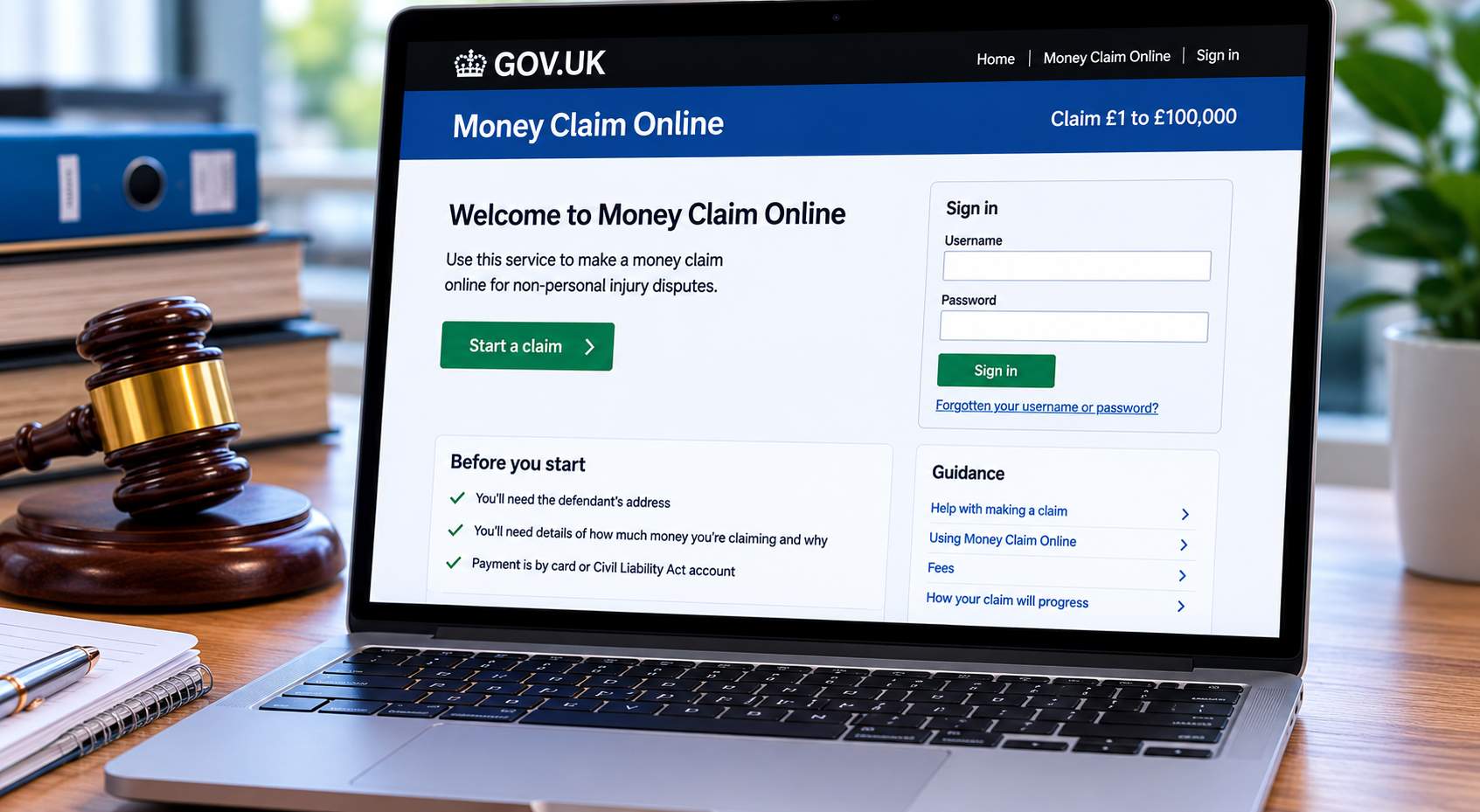
This is where Money Claim Online, more commonly known as MCOL, comes into the picture. Operated by HM Courts & Tribunals Service, MCOL provides a digital route for individuals and businesses to pursue certain money claims through the courts without the need for complex paperwork.
Although the process is designed to be accessible, many people remain unsure about how it works, when it should be used and whether it is the right option for their situation. Understanding the purpose and limitations of MCOL can help claimants make informed decisions before taking legal action.
What Is Money Claim Online (MCOL)?
Money Claim Online is an internet-based service that allows individuals and businesses to issue a county court claim for money they believe they are owed.
The service was introduced to simplify the process of bringing straightforward monetary disputes before the courts. Rather than completing paper forms and attending court offices, claimants can submit claims online and manage much of the process digitally.
MCOL is primarily intended for claims involving fixed sums of money. This means the claimant knows exactly how much they are seeking and can clearly explain why the money is owed.
The service applies to England and Wales and is often used as part of the small claims court process, although claims may ultimately be allocated to different court tracks depending on their value and complexity.
What Types of Disputes Can MCOL Be Used For.
One of the most common misconceptions is that MCOL can be used for any type of dispute. In reality, it is designed specifically for claims involving money.
Examples of situations where MCOL may be appropriate include unpaid invoices, outstanding loans between individuals, disputes over goods that were paid for but never delivered, faulty products where refunds have been refused, unpaid rent arrears and breaches of contract where a financial loss has occurred.
Small business owners frequently use MCOL to pursue overdue payments from customers or clients. Consumers also use the system when seeking compensation from traders who have failed to honour agreements or fulfil their obligations.
However, not every dispute is suitable for MCOL. Cases involving personal injury, housing possession matters, family law disputes or claims against individuals without a fixed address generally require different legal procedures.
When Should You Consider Using MCOL.
Court action should usually be viewed as a last resort rather than a first step.
Before issuing a claim, parties are expected to make reasonable efforts to resolve disputes directly. This may involve written correspondence, negotiation, mediation or formal complaints procedures.
In many cases, sending a detailed Letter Before Action can prompt a resolution without court involvement. This letter typically outlines the amount owed, the reasons for the claim and a deadline for payment or response.
MCOL becomes relevant when all reasonable attempts to settle the matter have failed and the claimant believes they have sufficient evidence to support their case.
Taking court action prematurely can sometimes weaken a claimant's position and may be viewed unfavourably if the court believes alternative resolution methods were not properly explored.
The Step-by-Step MCOL Process.
The MCOL process begins with the claimant creating an online account and completing details relating to the claim.
This includes information about both parties, the amount being claimed and the reasons the money is allegedly owed. Court fees are payable at the time of submission, with costs varying depending on the value of the claim.
Once submitted, the court formally issues the claim and serves it on the defendant. The defendant then has a limited period to respond.
Several outcomes are possible at this stage. The defendant may admit the claim and agree to pay. They may dispute the claim in full, partially admit liability or simply fail to respond altogether.
If no response is received within the required timeframe, the claimant may be able to request a default judgment. This means the court can rule in the claimant's favour without a hearing.
Where a claim is defended, the case may proceed through further stages before eventually being determined by a judge.
What Happens During the Small Claims Process.
Many people imagine dramatic courtroom confrontations when they think about legal proceedings. In reality, small claims hearings are generally more informal than higher court cases.
Judges often encourage parties to focus on facts, evidence and documentation rather than legal technicalities.
Both sides are typically given an opportunity to present their version of events, provide supporting evidence and answer questions relating to the dispute.
Evidence may include contracts, invoices, receipts, bank statements, emails, photographs or other relevant records.
The judge will then assess the evidence and make a decision based on the balance of probabilities. This means determining which version of events is more likely to be true.
What Evidence Do You Need.
Strong evidence is often the difference between success and failure in a small claims case.
Claimants should gather all documentation supporting their position before issuing proceedings. Missing evidence can significantly weaken an otherwise valid claim.
Written agreements, invoices, payment records, text messages and email correspondence often play a crucial role in establishing liability.
Businesses should maintain accurate records of transactions and communications. Consumers should retain receipts, contracts and proof of payment wherever possible.
Organised evidence not only strengthens a claim but can also encourage settlement before a hearing takes place.
Advantages of Using MCOL.
One of the main benefits of MCOL is accessibility. The online system allows claims to be issued quickly without requiring specialist legal knowledge.
For straightforward disputes, the process can be considerably more efficient than traditional paper-based procedures.
Costs are also relatively modest compared with many other forms of litigation. While fees still apply, they are often proportionate to the value of the claim being pursued.
Another advantage is that the process creates a formal framework for dispute resolution. Once court proceedings are initiated, defendants are often more likely to engage constructively and seek a settlement.
The possibility of a county court judgment can provide a strong incentive for parties to resolve matters promptly.
Potential Risks and Limitations.
Although MCOL offers a useful route for recovering money, success is never guaranteed.
Winning a judgment does not automatically result in payment. If a defendant refuses to pay despite losing the case, further enforcement action may be required.
This can involve bailiffs, attachment of earnings orders or other enforcement methods, each carrying additional costs and procedural requirements.
Claimants must also recognise the possibility of losing. If the court determines that the claim lacks merit, the claimant may lose the case and the fees paid to issue it.
Careful consideration should therefore be given before commencing legal proceedings.
Common Mistakes to Avoid.
Many unsuccessful claims stem from avoidable mistakes.
One of the most frequent errors is failing to keep adequate records. Without evidence, even a legitimate claim may struggle to succeed.
Another common issue is pursuing claims without first attempting to resolve disputes directly. Courts generally expect parties to communicate and explore settlement opportunities before litigation.
Some claimants also overestimate the strength of their case or underestimate the importance of preparation.
Reviewing evidence objectively and seeking professional advice where necessary can help avoid costly errors.
Is MCOL the Right Choice for You.
Money Claim Online has become an important tool within the civil justice system, helping individuals and businesses pursue legitimate financial claims efficiently and cost effectively.
For straightforward disputes involving unpaid debts, contractual disagreements or consumer issues, the service can provide a practical route to obtaining a court judgment.
However, legal action should never be entered into lightly. Understanding the process, gathering strong evidence and exploring alternative solutions first can significantly improve the chances of a successful outcome.
As more people turn to digital legal services, MCOL continues to play a growing role in helping claimants access justice while avoiding unnecessary complexity. For those owed money and unable to secure payment through negotiation alone, it may provide the solution they have been searching for.
Have you ever used the MCOL process or considered taking a small claims court case? Share your experience in the comments to help other readers understand what to expect.
Lifestyle News
Small Claims Court Secrets Every Consumer Should Know
Advertisement





Comments (0)
You must be logged in to post comments.
Don't have an account? Register here
No comments yet. Be the first to share your thoughts!