
Few British food arguments are conducted with such cheerful ferocity as the question of whether jam or cream goes on a scone first. It is a debate with no resolution, two entrenched positions and an entire tourist industry built around it.
Beneath the argument sits a genuinely old tradition, a protected regional product and a bread-like cake whose pronunciation causes almost as much trouble as its assembly.
Here is where the cream tea came from and why two neighbouring counties refuse to agree.
The origins are claimed by an abbey.
The most frequently cited origin story points to Tavistock Abbey in Devon, where Benedictine monks are said to have fed workers bread with clotted cream and preserves in the eleventh century, following the rebuilding of the abbey after a Viking raid.
The story is repeated widely and forms the backbone of Devon's claim to have invented the cream tea. Historians treat it with some caution, since the documentary evidence is thin and the account gained currency far later.
What is beyond dispute is that clotted cream has been produced in the West Country for centuries, and that combining it with bread and preserves is an obvious and ancient thing to do with what was available.
Clotted cream is a genuinely regional product.
Clotted cream is made by heating full cream milk slowly and then cooling it, allowing the cream to rise and form a thick crust. The result is far denser than whipped cream, with a distinctive yellow crust and a nutty flavour.
Cornish clotted cream holds Protected Designation of Origin status, meaning it can only be produced in Cornwall from milk sourced there and must meet a minimum butterfat content.
Devon produces clotted cream too, and Devonshire clotted cream is equally well regarded, though the protected designation belongs to its neighbour, a fact that has done nothing to calm relations.
The scone is more recent than the cream.
Scones as we know them depend on chemical raising agents, which only became widely available in the nineteenth century. Before that, similar griddle-baked breads existed across Britain, particularly in Scotland.
The word itself is thought to be of Scots origin, and early scones were large rounds cut into wedges rather than the individual risen circles now standard.
Afternoon tea as a social ritual, popularised in the mid-nineteenth century and credited to Anna, Duchess of Bedford, gave the scone the setting in which it became a national institution.
The order of assembly divides the two counties.
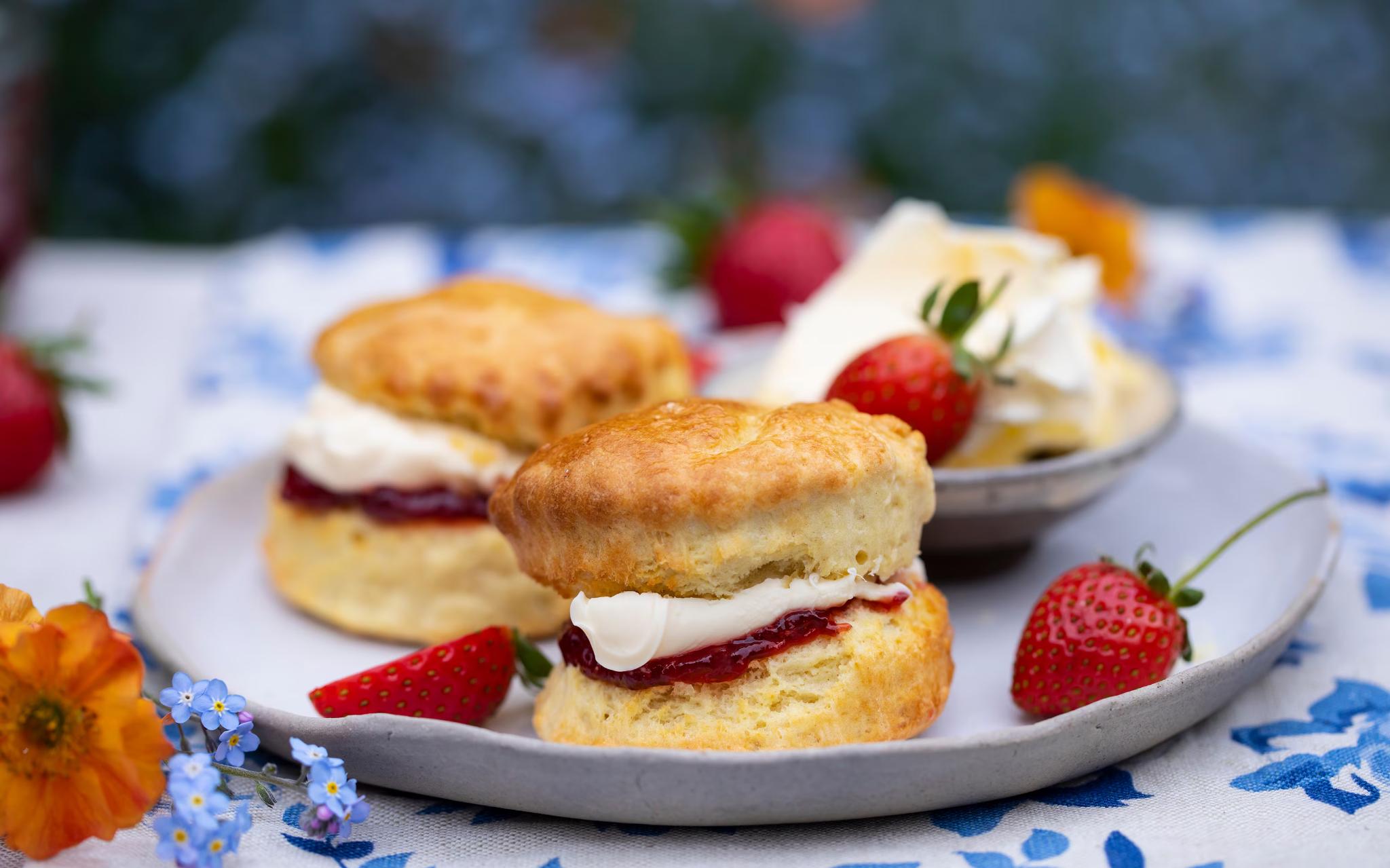
Here is the argument. The Devon method places clotted cream on the scone first, then a spoonful of jam on top. The Cornish method spreads jam first, then adds cream.
Both sides offer practical justification. Devon's supporters argue cream behaves like butter and should therefore go directly onto the scone. Cornwall's supporters argue jam applied first prevents the cream from being squashed and allows a more generous quantity.
The disagreement is genuine but good-natured, and both counties have made considerable use of it. National Trust properties have found themselves apologising after posting photographs assembled the wrong way round for the county they are in.
Nobody agrees on the pronunciation either.
The scone versus scone question, rhyming either with gone or with cone, cuts across regions and social class rather than following a neat geographical line.
Surveys have repeatedly found the shorter pronunciation more common in Scotland and the north of England, and the longer one more common in the south, but with substantial overlap everywhere.
There is no correct answer, which does not stop anyone asserting one.
What actually goes into a proper cream tea.
The standard components are two scones, clotted cream, strawberry jam and a pot of tea. Plain scones are traditional, though fruit scones are widely offered.
Purists object to alternatives such as cheese scones or flavoured creams, and to the substitution of whipped cream for clotted, which is generally regarded as the one genuinely unacceptable variation.
Tea should be properly brewed and served in a pot. This is the least contested element of the entire tradition.
Making them at home is straightforward.
Scones are among the easiest baked goods, provided the dough is handled as little as possible. Overworking develops gluten and produces a tough result rather than a light one.
The dough should be brought together quickly, patted out rather than rolled thin, and cut with a sharp cutter pressed straight down. Twisting the cutter seals the edges and prevents an even rise.
Buttermilk or milk soured with a little lemon juice reacts with the raising agent and improves the lift. A hot oven and a short bake are essential.
The tradition is thriving.
Cream teas remain a staple of village halls, garden centres, National Trust cafés and church fundraisers across the country, not only in the West Country.
They have also become a fixture of charity fundraising, with cream tea events raising substantial sums each year.
For a dish consisting of three ingredients and a pot of tea, it has proved remarkably durable, and the argument about assembly has almost certainly helped keep it in the public mind.
Share your thoughts.
Do you put Jam first or cream first on your scones?
Food & Drink News
The Cream Tea: Scones, Jam and the Great Divide
Two counties have argued for generations about the correct order of jam and cream, and neither shows any sign of backing down.
Advertisement

Comments (0)
You must be logged in to post comments.
Don't have an account? Register here
No comments yet. Be the first to share your thoughts!