
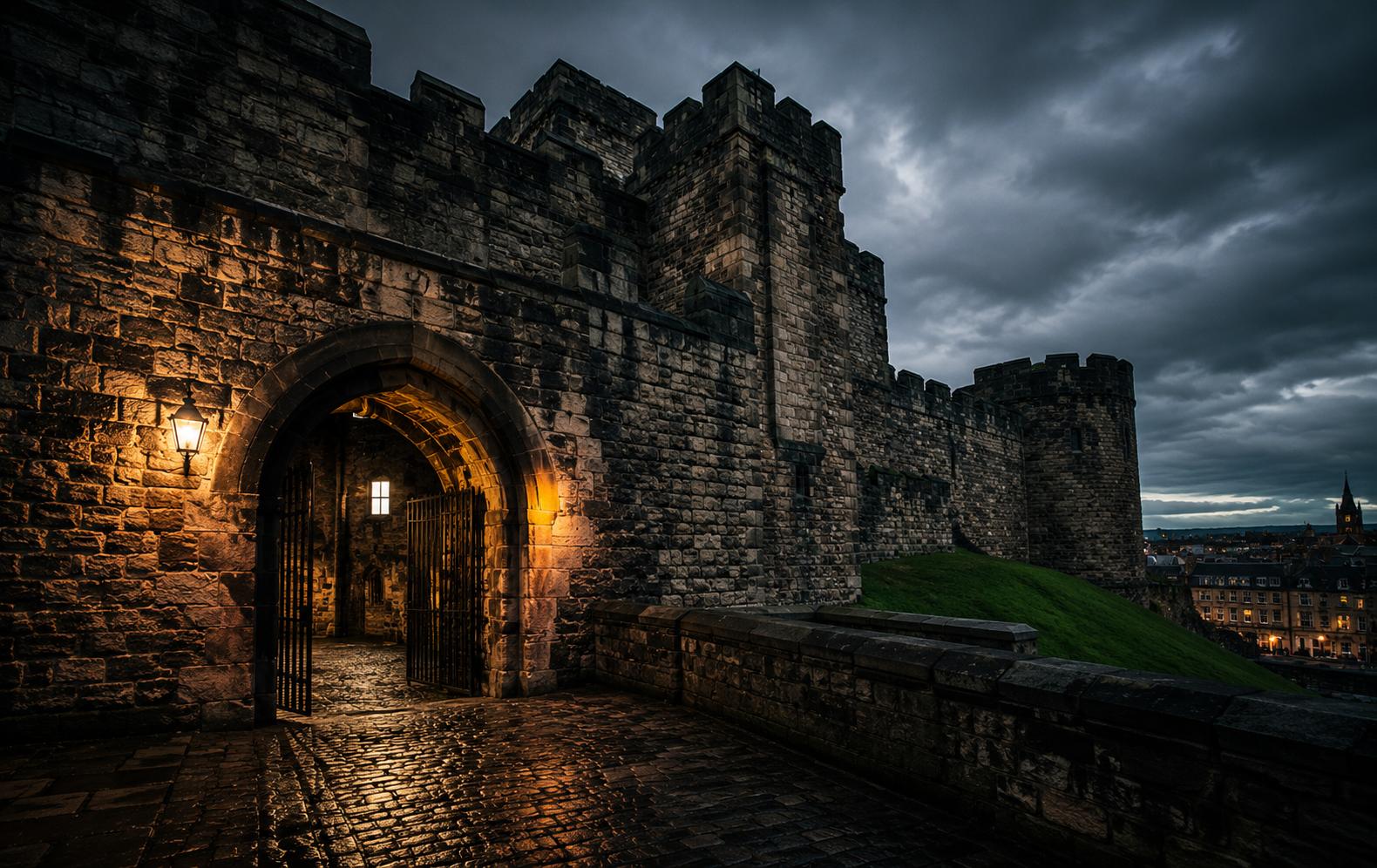
Standing above the city centre as commuters rush past and nightlife spills across Newcastle’s streets, Newcastle Castle remains one of the city’s most recognisable landmarks. For many people, it is simply part of the skyline. But hidden within its thick stone walls lies a darker and often forgotten history involving prisoners, executions, political conflict, and brutal medieval punishment.
Long before Newcastle became known for shopping, football, nightlife, and the Quayside, the castle was a symbol of military control and fear. Beneath the famous Castle Keep and Black Gate, prisoners were once locked away in cramped cells where many faced miserable conditions and uncertain futures.
Today, thousands visit Newcastle Castle every year to admire the historic architecture and panoramic city views. Yet few realise just how grim life once was for those trapped inside the fortress centuries ago.
The Fortress That Gave Newcastle Its Name.
Newcastle Castle dates back to the Norman period and is the very reason the city carries the name “Newcastle”. After William the Conqueror’s son Robert Curthose ordered the construction of a wooden fortification in 1080, the area became known as the “New Castle upon Tyne”.
The stone Castle Keep that still stands today was built later in the 12th century during the reign of King Henry II.
At the time, the fortress served multiple purposes. It acted as a military stronghold, a royal base, a defensive structure guarding the River Tyne, and a prison.
Its strategic location made Newcastle one of the most important towns in northern England, particularly during conflicts between England and Scotland.
Prisoners Once Held Beneath The Castle.
While the upper sections of the castle housed soldiers and officials, the lower chambers and dungeons became notorious for holding prisoners.
Some inmates were common criminals accused of theft or violence. Others were political prisoners, captured soldiers, rebels, or people awaiting execution.
Historical records suggest conditions inside the prison areas were harsh and deeply uncomfortable. Prisoners were often kept in dark stone chambers with little natural light, poor ventilation, and freezing temperatures during winter months.
Food was basic, sanitation was almost non-existent, and disease was a constant threat.
Unlike modern prisons, medieval imprisonment was not usually designed for rehabilitation. Many prisoners were simply held while awaiting trial, punishment, ransom, or execution.
The Black Gate’s Sinister Reputation.
One of the most haunting parts of Newcastle Castle is the Black Gate, the fortified gatehouse added during the 13th century.
Over time, the Black Gate developed a reputation as one of the grimmest parts of the complex. Prison cells within the gatehouse were used to detain criminals and debtors, with some prisoners spending months in confinement.
Historians believe overcrowding became a major issue during certain periods, especially as Newcastle’s population expanded.
The conditions inside were said to be filthy, damp, and dangerous. In some cases, prisoners relied on family members or charitable donations for food and basic survival.
By the 18th century, sections of the castle complex had deteriorated significantly, and parts of the Black Gate became associated with poverty and urban decay.
Executions And Punishment In Medieval Newcastle.
Punishment during medieval times was often brutal and public.
Prisoners held at Newcastle Castle could face whipping, branding, torture, or execution depending on the crimes they were accused of. Public executions were designed not only to punish offenders but also to act as warnings to others.
Some historians believe executions linked to Newcastle Castle likely took place close to the fortress itself, where crowds would gather to witness sentences being carried out.
The castle also played a role during periods of political unrest and rebellion. Captured rebels and enemies of the Crown were sometimes imprisoned within its walls before facing punishment.
During the English Civil War in the 17th century, Newcastle became a strategically important location once again, with the castle witnessing military occupation and conflict.
Newcastle Castle’s Links To Scottish Wars.
Because of Newcastle’s position close to the Scottish border, the castle became deeply connected to centuries of Anglo-Scottish conflict.
Scottish prisoners captured during border wars were occasionally held within Newcastle Castle, while the fortress itself faced repeated threats during invasions and uprisings.
The city was considered one of England’s key northern defensive strongholds, making the castle vital to royal power.
Many historians believe fear and uncertainty would have been constant realities inside the prison chambers during wartime periods.
Rumours Of Ghosts And Paranormal Activity.
Given its violent and unsettling history, it is perhaps no surprise that Newcastle Castle has long been linked to ghost stories and paranormal sightings.
Staff, visitors, and paranormal investigators have all reported strange experiences over the years, particularly around the castle’s darker underground areas.
Some claim to have heard unexplained footsteps, whispers, or sudden temperature drops inside the ancient stone corridors.
While there is no evidence proving supernatural activity, the atmosphere inside parts of the castle can feel eerie, especially when exploring the dimly lit prison spaces and narrow staircases.
Ghost tours and historical night events have become increasingly popular, attracting visitors fascinated by Newcastle’s darker past.
A Historic Landmark That Still Fascinates Visitors.
Today, Newcastle Castle stands as one of the city’s most important historical attractions.
Visitors can explore the medieval chambers, climb the ancient staircases, and learn about the fortress that helped shape Newcastle’s identity for nearly 1,000 years.
While modern Newcastle is known for its vibrant nightlife and busy city centre, the castle offers a reminder of the harsh realities that once existed behind its walls.
For many residents and tourists alike, the building remains both fascinating and unsettling - a place where history feels unusually close.
Its prison cells, military history, and stories of punishment continue to capture the imagination of people interested in Newcastle’s hidden past.
Have you ever visited Newcastle Castle or explored its underground chambers? Share your experiences, ghost stories, or favourite Newcastle history facts in the comments below.
Newcastle History
The Dark History of Newcastle Castle and the Prisoners Once Locked Inside Its Medieval Walls
Advertisement


Comments (0)
You must be logged in to post comments.
Don't have an account? Register here
No comments yet. Be the first to share your thoughts!