
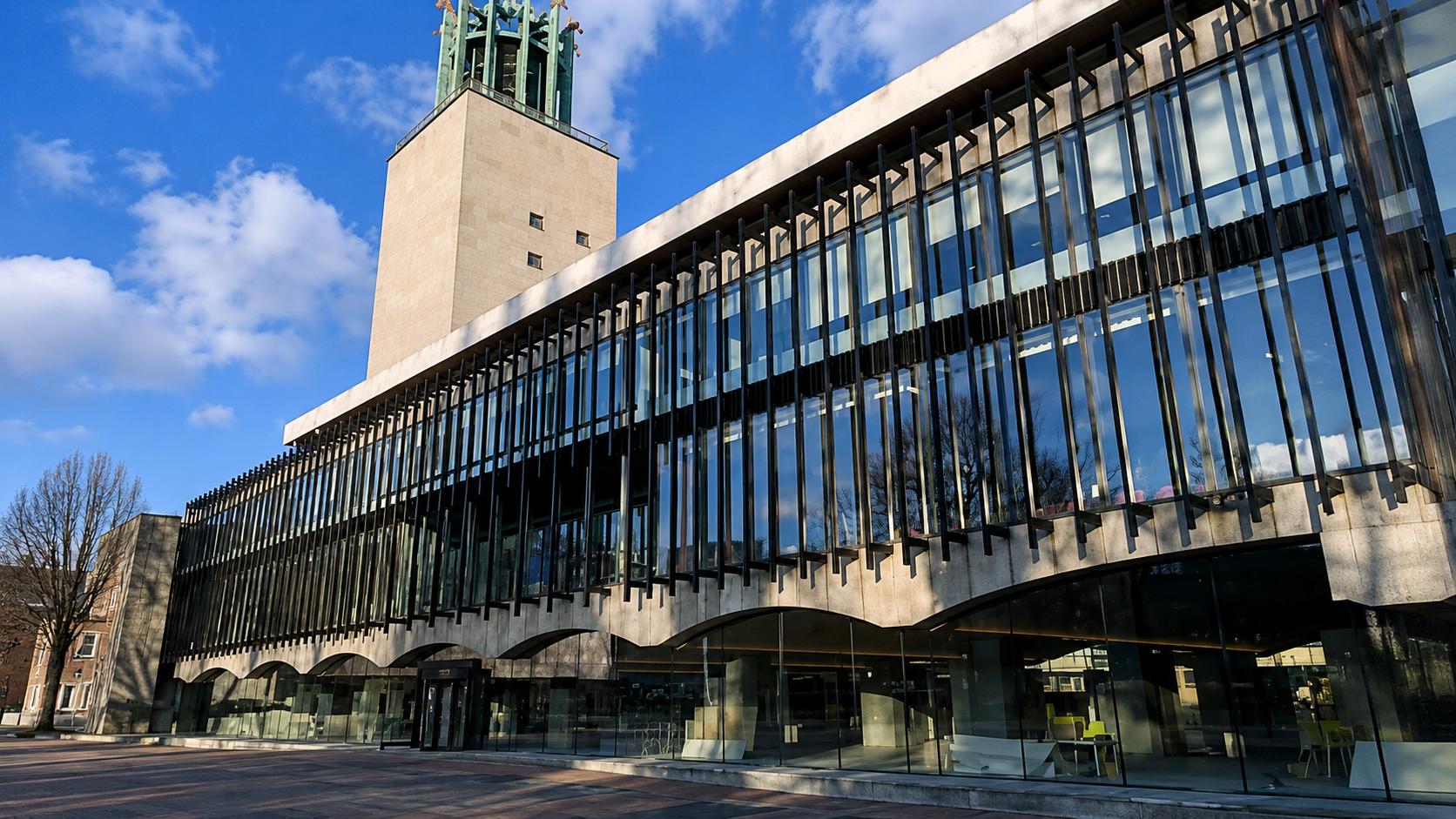
Newcastle Civic Centre stands today as the main administrative and ceremonial headquarters of Newcastle City Council, occupying a prominent site in the Haymarket area of the city centre. Standing two hundred feet tall and instantly recognisable by its distinctive seahorse-topped carillon tower, the building remains one of the most striking examples of post-war civic architecture anywhere in the North East.
Plans for a new Newcastle city hall on the Barras Bridge site actually date back before the Second World War, with an architectural competition held during the 1930s before those original proposals were halted entirely by the outbreak of war. Post-war restrictions on capital spending delayed the project considerably further, meaning formal authorisation to finally begin construction was not granted until August 1956.
The building was designed by George Kenyon, who served as Newcastle's City Architect from 1947 until 1973 and had earlier gained construction experience working on New York's Empire State Building during the 1920s. Construction work, undertaken by contractor Sir Robert McAlpine, began on site in May 1960, with the foundation stone formally laid by the Lord Mayor, Alderman Mrs Gladys Robson, on 30 November that year.
The timing of the Civic Centre's construction placed it directly at the heart of Newcastle's most ambitious era of post-war redevelopment, coinciding almost exactly with T. Dan Smith's period as council leader between 1960 and 1965. The building embodied the same confident, modernist civic ambition that characterised Smith's wider vision for transforming Newcastle, standing as arguably the most enduring, and least controversial, physical legacy of that entire era.
Construction was completed in 1967, at a total cost of £4,855,000, though the building was not formally opened until 14 November 1968, when King Olav V of Norway performed the official opening ceremony, a choice reflecting the strong historical trading and cultural ties between Newcastle and Scandinavia built up over many previous centuries of maritime connection across the North Sea.
The Civic Centre replaced Newcastle's Victorian town hall in St Nicholas Square, which was subsequently demolished in 1973 once the new building had become fully operational. The Civic Centre incorporates a genuinely significant collection of public art specifically commissioned for the building, including the bronze River God Tyne sculpture and a separate Swans in Flight sculpture, both by David Wynne, alongside abstract murals by Victor Pasmore and a tapestry by John Piper.
The building received Grade II* listed status in November 1995, formally recognising its considerable architectural and historical significance, and was later included among the Twentieth Century Society's list of one hundred nationally significant buildings marking one hundred years of twentieth-century British architecture, cementing its reputation as a genuinely important example of the era's civic design well beyond Newcastle itself.
The building's design incorporated genuinely distinctive architectural features throughout, including an elliptical council chamber with exposed concrete walls that drew both admiration and criticism at the time of construction, with one contemporary architectural review famously describing the entire Civic Centre as a "flamboyant folly" built in a city that many critics felt needed the same funding directed toward more essential everyday public services instead.
Despite that initial criticism, the Civic Centre has since been recognised as a building of genuine national architectural significance, included by the Twentieth Century Society within its list of one hundred nationally important buildings marking a century of British architecture, a considerable reassessment of a structure once dismissed by some contemporary critics as an extravagant, unnecessary use of public funds during a period of otherwise limited council spending.
More recently, the Civic Centre has faced genuine practical challenges around rising maintenance costs, prompting the council to approve a significant multi-million-pound refurbishment programme aimed at making parts of the building available to other organisations, including court services, to help offset the considerable ongoing cost of maintaining such a large, architecturally protected building well into the twenty-first century.
The building's continued use as Newcastle's primary seat of local government, more than half a century after its construction began, speaks to the genuine durability of Kenyon's original architectural vision. It stands today as a genuinely rare survivor of a particular, ambitious era of British civic architecture rarely attempted again since. Few council buildings anywhere in England can claim quite so distinguished a list of public artists contributing to a single structure.
Join the conversation below.
Have you ever visited Newcastle's Civic Centre in person?
Political News
The History of Newcastle's Civic Centre
Newcastle's striking modernist Civic Centre took over a decade to build, replaced a Victorian town hall, and was formally opened by a Norwegian king. Its story is closely tied to one of the city's most ambitious eras of redevelopment.
Advertisement


Comments (0)
You must be logged in to post comments.
Don't have an account? Register here
No comments yet. Be the first to share your thoughts!