
The North East's footballing reputation rests on three professional clubs, but the game here runs considerably deeper than that.
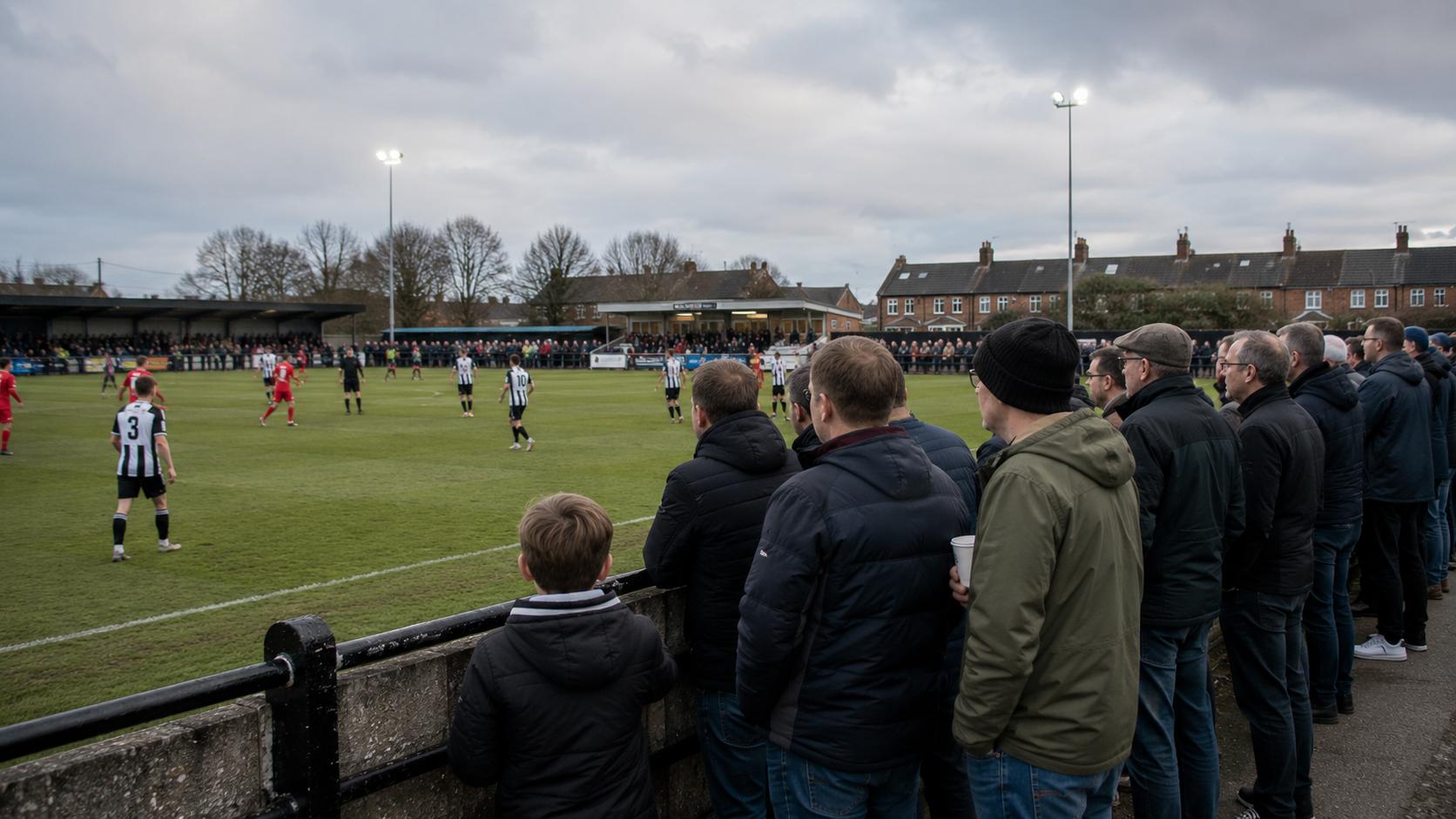
Across Tyneside, Wearside, Northumberland and County Durham, dozens of clubs play in front of crowds that would surprise anyone who assumes non-league means empty terraces and no history.
Here is a guide to the scene and the stories that define it.
Blyth Spartans set the standard.
No North East non-league club is better known nationally, and it is because of one extraordinary run.
In the 1977-78 season, Blyth Spartans reached the fifth round of the FA Cup, beating league opposition along the way. They drew with Wrexham away, and the replay was moved to St James' Park to accommodate demand.
More than forty thousand people attended. Blyth lost, but the run entered FA Cup folklore and is still cited whenever a non-league side draws a big club.
The club has produced further cup runs since and remains one of the best-supported at its level.
South Shields rebuilt from nothing.
South Shields FC provides one of the most striking recent stories in English non-league football.
The club had spent years in decline and had at one point been playing outside the town altogether. New ownership from 2015 brought investment, a return to Mariners Park and a rapid climb through the divisions.
In 2017 the club won the FA Vase at Wembley in the same season it won its league, in front of a crowd that filled a substantial section of the national stadium.
Attendances have since been among the highest at its level in the country, demonstrating the appetite for football in a town without a professional club.
Gateshead have been the region's non-league flagship.
Gateshead FC play at the Gateshead International Stadium and have spent extended periods in the National League, the highest tier of non-league football.
The club has come close to returning to the Football League on more than one occasion, including reaching the play-off final in 2014.
Its history includes a period as a Football League club, and it has faced significant financial and administrative difficulties at various points, from which it has repeatedly recovered.
Darlington were reborn by their supporters.
Darlington's story is a cautionary tale and a triumph in roughly equal measure.
The club, a Football League member for most of the twentieth century, was liquidated in 2012 after years of financial trouble compounded by the construction of a stadium far larger than the club could sustain.
Supporters reformed the club as Darlington 1883, starting several divisions below and rebuilding from the ground up. The club subsequently returned to playing in the town after a period groundsharing elsewhere.
It is one of the clearest examples in English football of a supporter-led rescue.
Bishop Auckland dominated the amateur era.
Before the distinction between amateur and professional football was abolished, Bishop Auckland were among the most successful clubs in the country.
The club won the FA Amateur Cup a record number of times and regularly played in front of large crowds at Wembley finals, at a time when amateur football attracted genuine national attention.
That history is not widely known outside the region, but it represents one of the strongest records of any club in English football.
Whitley Bay made the Vase their own.
Whitley Bay won the FA Vase in three consecutive seasons between 2009 and 2011, an achievement no other club has matched.
Those Wembley appearances brought substantial support down from the coast and demonstrated the strength of the region's clubs at that level.
Spennymoor Town, Consett, Morpeth Town and others have added further Wembley appearances and finals since, making the North East one of the most consistently successful regions in the competition.
Hartlepool have moved between the tiers.
Hartlepool United spent decades in the Football League before relegation to the National League, followed by promotion and subsequent relegation again.
The club's supporters have remained notably loyal through those swings, and Victoria Park continues to draw crowds that most non-league clubs would envy.
Its position illustrates how narrow the line has become between the bottom of the Football League and the top of non-league.
The pyramid connects everything.
The Northern League, founded in 1889, is among the oldest football leagues in the world and remains the backbone of the regional non-league structure.
Its clubs feed players upward into the professional game and provide the competitive structure that sustains football in towns and villages across Northumberland and Durham.
Promotion and relegation link every level, which means a village side can, in principle, climb towards the Football League, and several North East clubs have done exactly that within living memory.
Watching is cheap and close.
For supporters priced out of the professional game, non-league offers a genuine alternative.
Admission is typically a fraction of Premier League or Championship prices, there is no ticketing ballot, and the distance between spectator and pitch is measured in feet rather than tiers.
Clubs are volunteer-heavy operations, and most welcome anyone willing to help. Bars are usually open, food is cheap, and standing is still permitted.
For anyone who has never tried it, the region offers more options within half an hour's travel than almost anywhere in England.
Share your thoughts.
Which North East non-league club would you send a first-timer to watch?
Sports News
The North East Non-League Football Scene
Below the professional game sits a network of clubs with cup runs, Wembley finals and crowds that would embarrass some league sides.
Advertisement



Comments (0)
You must be logged in to post comments.
Don't have an account? Register here
No comments yet. Be the first to share your thoughts!