
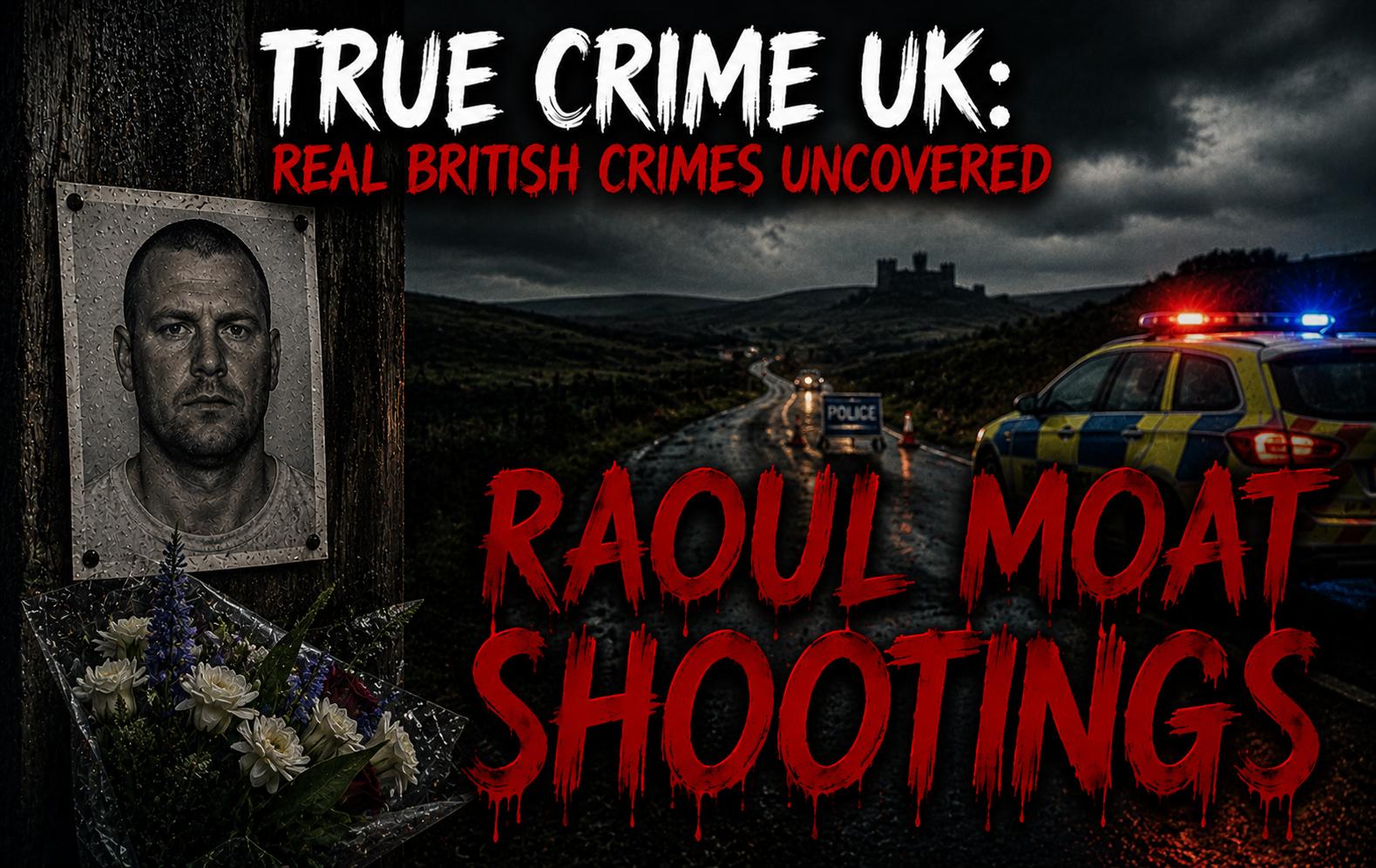
In July 2010, the quiet towns and countryside of Northumberland became the centre of one of Britain’s most dramatic and terrifying manhunts. Over the course of several days, former nightclub bouncer Raoul Moat carried out a series of shootings that left one person dead, another permanently blinded, and police officers across the UK involved in a massive armed operation.
The Raoul Moat shootings shocked the nation not only because of the violence involved, but because the case unfolded live in front of the British public. News helicopters tracked police convoys, rolling television coverage followed every development, and millions watched as one of the largest manhunts in modern British history intensified.
More than a decade later, the Raoul Moat case remains one of the most infamous crime stories Britain has ever witnessed.
Who Was Raoul Moat?
Raoul Moat was a 37-year-old former nightclub doorman and bodybuilder from Newcastle upon Tyne. Friends described him as physically intimidating, emotionally volatile, and increasingly paranoid in the months leading up to the shootings.
Before the attacks, Moat had already served time in prison for assault. While incarcerated, his personal life reportedly deteriorated further, particularly his relationship with his former girlfriend Samantha Stobbart.
According to investigators, Moat became obsessed with the belief that Stobbart had begun dating a police officer during his imprisonment. That belief would later become central to the violence that followed.
After his release from Durham Prison on July 1, 2010, Moat’s behaviour rapidly escalated.
Within days, Northumberland would be plunged into fear.
The First Shooting.
Late on the night of July 3, 2010, Raoul Moat travelled to Birtley, near Gateshead, armed with a shotgun.
There, he confronted Samantha Stobbart and her new partner, 29-year-old Chris Brown, outside her home.
Without warning, Moat opened fire.
Chris Brown suffered catastrophic shotgun injuries and died at the scene. Samantha Stobbart was also shot and seriously wounded but survived after emergency surgery.
The violence of the attack horrified investigators.
Witnesses described scenes of panic as neighbours rushed to help while emergency services flooded the residential street. Blood stained the pavement outside the property as armed police quickly launched a murder investigation.
Almost immediately, officers realised Moat posed an ongoing threat.
Moat Declares War on Police.
After the shootings, Raoul Moat disappeared.
Before vanishing, he reportedly left behind letters and recorded messages expressing hatred toward police officers. In one message, he claimed he intended to target police specifically.
The warning would soon prove deadly.
Just hours later, on July 4, traffic officer PC David Rathband was sitting in his patrol car near East Denton roundabout in Newcastle when Moat approached unexpectedly.
Standing beside the vehicle, Moat fired a shotgun directly through the window at close range.
The blast caused devastating facial injuries.
Although Rathband survived the attack, he was permanently blinded. The shooting deeply shocked police forces across Britain and intensified fears surrounding Moat’s growing campaign of violence.
Northumbria Police now faced an armed suspect actively targeting officers.
The Nationwide Manhunt.
Following the shootings, one of the largest manhunts in British criminal history began.
Hundreds of armed officers searched forests, farmland, rivers, and rural villages across Northumberland. Helicopters equipped with thermal imaging technology scanned remote areas while roadblocks appeared throughout the region.
Public fear escalated rapidly.
Residents were warned to remain indoors and report suspicious sightings immediately. Schools increased security measures, while local businesses closed early amid concerns Moat could strike again.
News coverage dominated British television.
Images of heavily armed police officers searching woodland areas became a constant feature across newspapers and rolling news broadcasts. The manhunt quickly evolved into a national obsession.
As days passed, pressure mounted on investigators to locate Moat before more violence occurred.
The Rothbury Standoff.
On July 8, 2010, police received reports that Moat had been spotted near the small town of Rothbury in Northumberland.
Officers descended on the area, triggering a tense overnight search through nearby riverside woodland.
Eventually, armed police located Moat hiding near the banks of the River Coquet.
What followed became one of the most watched police standoffs in British history.
For hours, negotiators attempted to persuade Moat to surrender peacefully. Armed officers surrounded the area while television cameras broadcast developments live from nearby roads.
Crowds gathered behind police lines as tension continued building deep into the night.
At one stage, former footballer Paul Gascoigne unexpectedly arrived near the scene carrying food and beer, bizarrely claiming he wanted to help Moat. The surreal moment only added to the intense media frenzy already surrounding the case.
Behind the scenes, negotiators desperately tried preventing further bloodshed.
The Final Moments.
As negotiations continued into the early hours of July 10, police deployed stun devices in an attempt to disorient Moat and safely end the standoff.
Moments later, a single gunshot rang out.
Raoul Moat had turned the shotgun on himself.
Paramedics rushed to the scene and attempted emergency treatment, but Moat died shortly afterwards.
The seven-day manhunt was finally over.
Across Britain, reactions were mixed. Many felt relief that the threat had ended, while others reflected on the devastating consequences of the shootings and the emotional toll placed on victims, families, and police officers involved.
The Impact on Victims and Communities.
The Raoul Moat shootings left lasting scars across Northumberland and beyond.
Chris Brown’s family mourned the loss of a young man killed in an act of explosive violence. Samantha Stobbart faced years of emotional recovery following the traumatic attack.
For PC David Rathband, the injuries proved life-changing.
Blinded permanently by the shooting, Rathband later became a public advocate for injured officers and trauma survivors. Tragically, he struggled deeply with depression in the years following the attack and died in 2012.
The case also sparked widespread discussion regarding mental health, violent masculinity, domestic abuse, and media sensationalism.
Many critics later questioned whether parts of the media had dangerously glamorised Moat during the manhunt by portraying him as an anti-establishment figure rather than a violent offender.
The Legacy of the Raoul Moat Case.
Even years later, the Raoul Moat shootings remain one of the most unforgettable crime stories in British history.
The combination of domestic violence, attacks on police officers, a dramatic armed manhunt, and live televised coverage created a case unlike almost any seen before in the UK.
For many people, the story serves as a chilling reminder of how quickly personal obsession and violent rage can spiral into national tragedy.
The events of July 2010 continue to resonate deeply within British true crime history - not only because of the violence itself, but because the entire nation watched it unfold in real time.
Do you believe the media coverage surrounding the Raoul Moat manhunt crossed ethical lines during the investigation?
Share your thoughts in the comments and join the discussion on one of Britain’s most shocking modern crime cases.
Crime News
True Crime UK: Inside the 2010 Northumberland Manhunt That Shocked Britain
Warning: This article contains discussion of abduction, murder, violence, and other themes that some readers may find distressing.
Advertisement

Comments (0)
You must be logged in to post comments.
Don't have an account? Register here
No comments yet. Be the first to share your thoughts!