
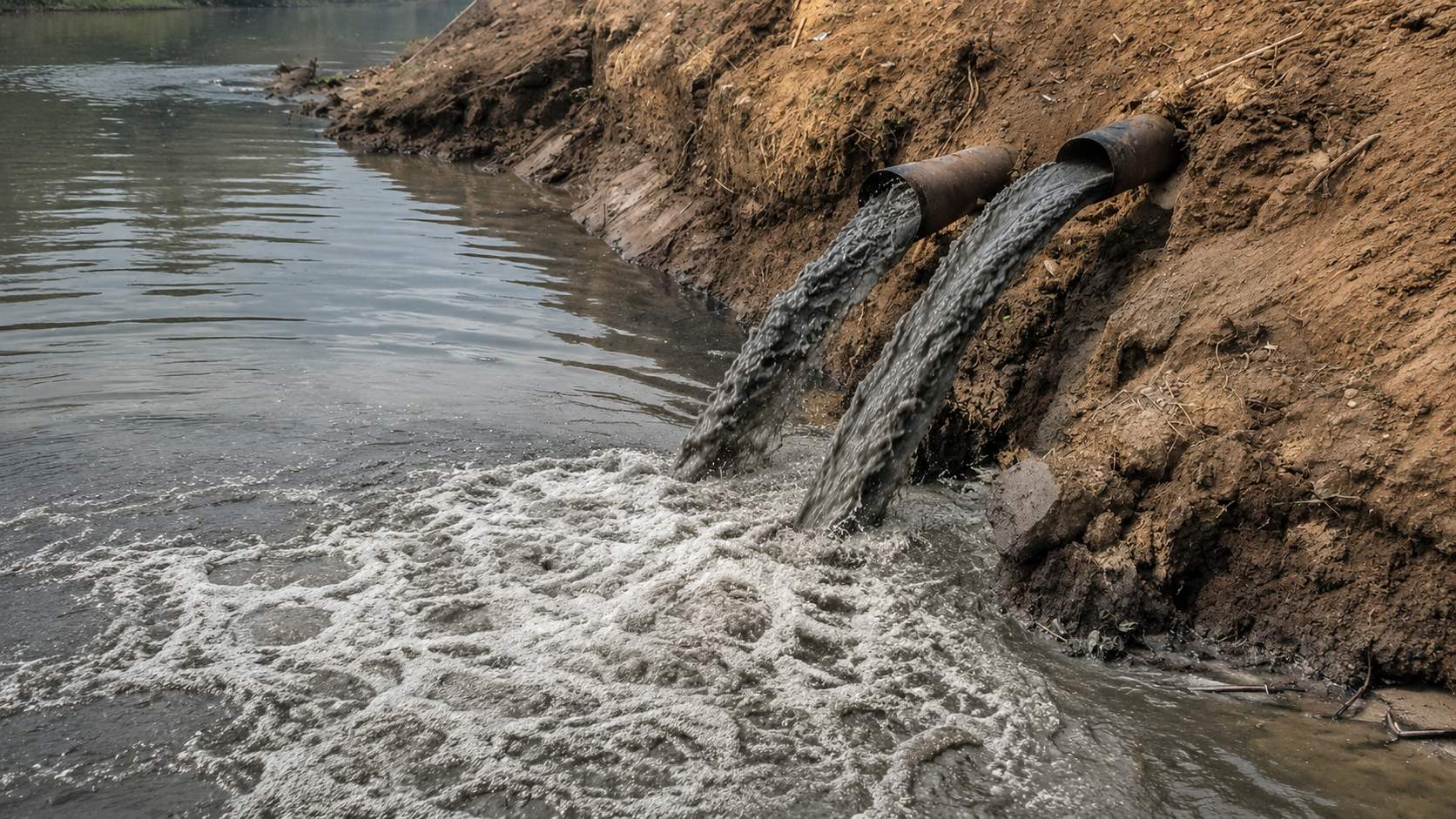
Storm overflows discharged sewage into the River Tyne’s saline estuary 840 times during 2025, according to analysis of Environment Agency Event Duration Monitoring returns.
Monitors at 23 Northumbrian Water sites recorded a combined discharge duration of approximately 5,716 hours. That is an average of 2.3 spills a day and amounts to 238 days when the hours are added together.
However, this does not mean sewage entered the Tyne continuously for 238 days. Several outfalls can operate simultaneously, so overlapping discharge hours may be counted more than once.
The data also measures how long each storm overflow operated, not the amount of sewage released. A short discharge from a large outfall could potentially release more wastewater than a longer event at a smaller site.
Even with those limitations, the figures reveal the scale and concentration of sewage discharges along one of the North East’s most important waterways.
Howdon recorded the longest discharge duration.
Howdon Sewage Treatment Works recorded by far the longest total discharge time during 2025. Its monitored storm overflow operated 266 times for a combined 2,220 hours.
That is equivalent to approximately 92.5 days, or more than a quarter of the entire year. It also means Howdon accounted for almost 39 per cent of all discharge hours recorded across the River Tyne saline estuary.
Glasshouse Street Pumping Station had the second-highest total. Its overflow operated 128 times for 1,353 hours, equivalent to 56.4 days.
Wagonway Road Pumping Station followed with 100 spills lasting a combined 1,085 hours. That is just over 45 days of recorded operation.
Together, Howdon, Glasshouse Street and Wagonway Road were responsible for 4,658 of the Tyne’s 5,716 monitored discharge hours. In other words, three sites accounted for approximately 81 per cent of the total.
Other Tyne outfalls also recorded lengthy spills.
The gap between the three busiest sites and the remaining outfalls was considerable. However, several other locations still discharged for days when their annual operating hours were combined.
Spillers Pumping Station recorded 57 spills lasting 255 hours, equivalent to 10.6 days. New Welbeck Road Pumping Station operated 34 times for 164 hours, or approximately 6.8 days.
Dunston Flour Mill West CSO recorded only 14 spills, but they lasted for a combined 146 hours. This produced an average of more than 10 hours per counted spill.
Ouseburn West Pumping Station recorded 38 separate incidents lasting 129 hours, equivalent to approximately 5.4 days. Wincomblee C Pumping Station discharged 22 times for 97 hours, or just over four days.
Further down the list, International Paints Pumping Station recorded 57 hours, Burwell Avenue CSO recorded 54 and Low Heworth Lane Pumping Station recorded 38.
Ouseburn East Pumping Station discharged 12 times for a combined 15 hours. Blackett Street CSO operated 10 times for 11 hours, while several monitored locations reported no discharge time during 2025.
Newcastle’s wider sewage figures were also significant.
When the data is examined by parliamentary constituency rather than by one named section of the Tyne, Newcastle’s wider totals remain substantial.
Newcastle upon Tyne Central and West recorded 585 sewage spills lasting a combined 1,239 hours across 26 sites. Broad Chare CSO had the longest duration in that area, with 43 recorded spills lasting 246 hours.
Denton Road CSO operated 78 times for 185 hours, while Milk Market Pumping Station recorded 29 spills lasting 145 hours. Silver Lonnen CSO added another 121 hours from 54 incidents.
Newcastle upon Tyne East and Wallsend recorded 907 spills lasting 3,317 hours across 35 sites. Glasshouse Street Pumping Station made up a large proportion of that total.
These constituency figures include discharges into the Tyne, Ouseburn, Wallsend Burn and connected waterways. They should not be added directly to the saline-estuary total because some sites appear in both geographical groupings.
Incomplete monitoring could hide the full picture.
Most of the named Tyne monitors operated for the large majority of 2025, but data coverage was incomplete at several locations.
Broad Chare CSO reported monitor operation for only 39.8 per cent of the year. A Newcastle upon Tyne CSO in the East and Wallsend constituency had 35.6 per cent coverage.
Wincomblee Road CSO reported 65.8 per cent, while monitoring at Ouseburn West Pumping Station covered 88.4 per cent of the year.
This does not prove additional unrecorded spills occurred. It does mean annual totals for sites with low monitoring coverage should be treated cautiously because part of the year is missing.
Why storm overflows discharge sewage.
Many older North East sewers carry rainwater and household wastewater through the same pipes. During heavy rainfall, the system can become overwhelmed.
Storm overflows act as pressure-release points, allowing diluted untreated wastewater to enter rivers rather than backing up into homes, businesses and streets.
These discharges can be permitted under defined conditions. However, dry-weather spills, poor maintenance or operation outside permit requirements may lead to an Environment Agency investigation.
An Event Duration Monitor records when an overflow starts and stops. Its activation alone does not prove that a company has broken the law.
Why the Tyne figures matter.
The tidal Tyne supports fish, birds and other wildlife while also being used for rowing, angling, paddle sports and riverside recreation.
Sewage discharges can introduce bacteria, nutrients, sanitary waste and organic material into the water. The risk at any particular time depends on the volume released, tides, rainfall and river conditions.
The 2025 figures leave one crucial question unanswered. Residents can see how often an overflow operated and for how long, but they are not told how many litres of wastewater entered the Tyne.
Publishing reliable volume estimates alongside discharge hours would give the public a much clearer picture of the environmental impact.
The data shows that focusing investment on a handful of major outfalls could make a substantial difference. With three sites responsible for four-fifths of recorded discharge hours, campaigners will expect clear explanations, firm improvement deadlines and evidence that the longest spills are being reduced.
Share your views below.
Is it acceptable for one Tyne outfall to operate for 2,220 hours in a year?
Community News
Tyne Sewage Spills Lasted a Shocking 5,716 Hours
Advertisement





Comments (0)
You must be logged in to post comments.
Don't have an account? Register here
No comments yet. Be the first to share your thoughts!