
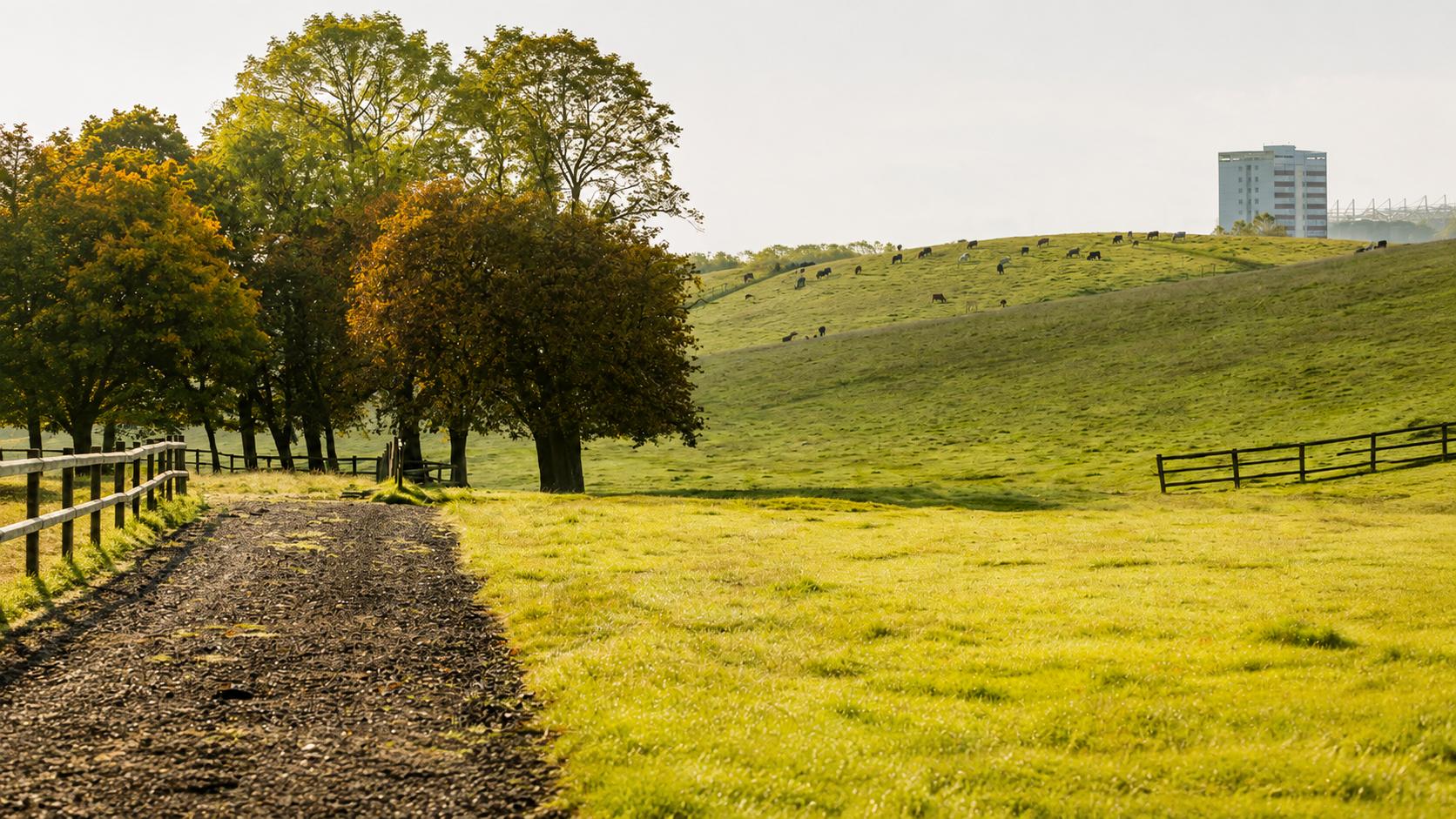
Most cities would have built on it decades ago. Newcastle has around a thousand acres of open grazing land sitting a short walk from Grey's Monument, and every so often somebody spots a cow on it and asks the obvious question.
Who owns the Town Moor, and why is there livestock in the middle of a major English city?
The answer involves a medieval trade guild, an eighteenth-century legal settlement, and a set of rights that has survived every attempt to build over them.
The land belongs to the council, but not freely.
Newcastle City Council holds the freehold of the Town Moor. That much is straightforward. What is not straightforward is what the council is allowed to do with it.
The Freemen of Newcastle hold ancient grazing rights over the land, known as the right of herbage. Those rights are not a courtesy or a tradition that the council could withdraw. They are legal interests, confirmed and re-confirmed by Parliament.
The result is a form of shared control. The council owns the soil. The Freemen have the right to graze it. Neither can act on the Moor without the other.
An eighteenth-century row settled it.
The arrangement in its modern form dates to a dispute in the 1770s, when the Freemen took the Corporation of Newcastle to law over attempts to lease and enclose parts of the Moor.
The settlement that followed was confirmed by an Act of Parliament in 1774, which restricted what could be done with the land and secured the grazing rights in statute.
Further legislation has updated the arrangements since, most significantly a 1988 Act that modernised the management structure while keeping the essential protections in place.
The practical effect has been remarkable. Land that would have been worth an extraordinary amount as development plots has stayed open for two and a half centuries.
Who counts as a Freeman.
Freedom of the city was historically tied to the trade guilds, or companies, of Newcastle. Membership came through completing an apprenticeship, through patrimony as the child of a Freeman, or through marriage in certain circumstances.
The guilds still exist, with names that read like a directory of vanished trades: joiners, saddlers, coopers, ropemakers, house carpenters and many more.
Admission today runs largely through patrimony, and the rules have been reformed to allow daughters as well as sons to inherit the freedom. That change substantially widened the pool of people entitled to claim it.
It is worth noting that this is different from being granted the Freedom of the City as an honour, which is a ceremonial award made by the council to individuals it wishes to recognise.
The cattle are not decorative.
Grazing on the Moor is real agricultural activity. Cattle are put out during the grazing season by graziers who hold the right to do so, and they are working animals rather than an attraction.
They also do a job that no council grounds maintenance budget could match. Grazing keeps the sward short, maintains the grassland habitat and costs nothing in mowing.
Visitors who are unused to livestock sometimes underestimate them. Cattle are generally placid but they are large animals, and the standard advice applies: keep dogs on leads, do not walk between a cow and a calf, and give the herd space.
The Moor does more than graze.
The Hoppings, one of the largest travelling fairs in Europe, sets up on the Moor each summer under arrangements that respect the grazing rights rather than overriding them.
Exhibition Park, Nuns Moor, Castle Leazes and Duke's Moor form part of the wider moorland complex, and the Newcastle Racecourse at Gosforth Park sits on separate land nearby with its own history.
The Great North Run, university sport, dog walking, cross-country running and a substantial amount of ordinary daily exercise all happen on ground that exists in its current form because of a legal argument settled before the city had gas lighting.
Why it still matters.
Newcastle has a housing shortage, and open land close to the centre is exactly what developers look for. The Moor is one of the few places where the argument does not even begin, because the legal position makes it extraordinarily difficult to build on.
That protection is unusual. Most cities lost their common land through enclosure. Newcastle kept its because a group of tradesmen were prepared to go to court about it.
Whether that is an accident of history or an early piece of green belt planning depends on your point of view, but the outcome is a city with genuine open country inside its ring road.
Share your thoughts.
Should Newcastle's protected common land ever be considered for development?
Local News
Who Actually Owns the Town Moor? The Freemen and Their Grazing Rights
Advertisement


Comments (0)
You must be logged in to post comments.
Don't have an account? Register here
No comments yet. Be the first to share your thoughts!