
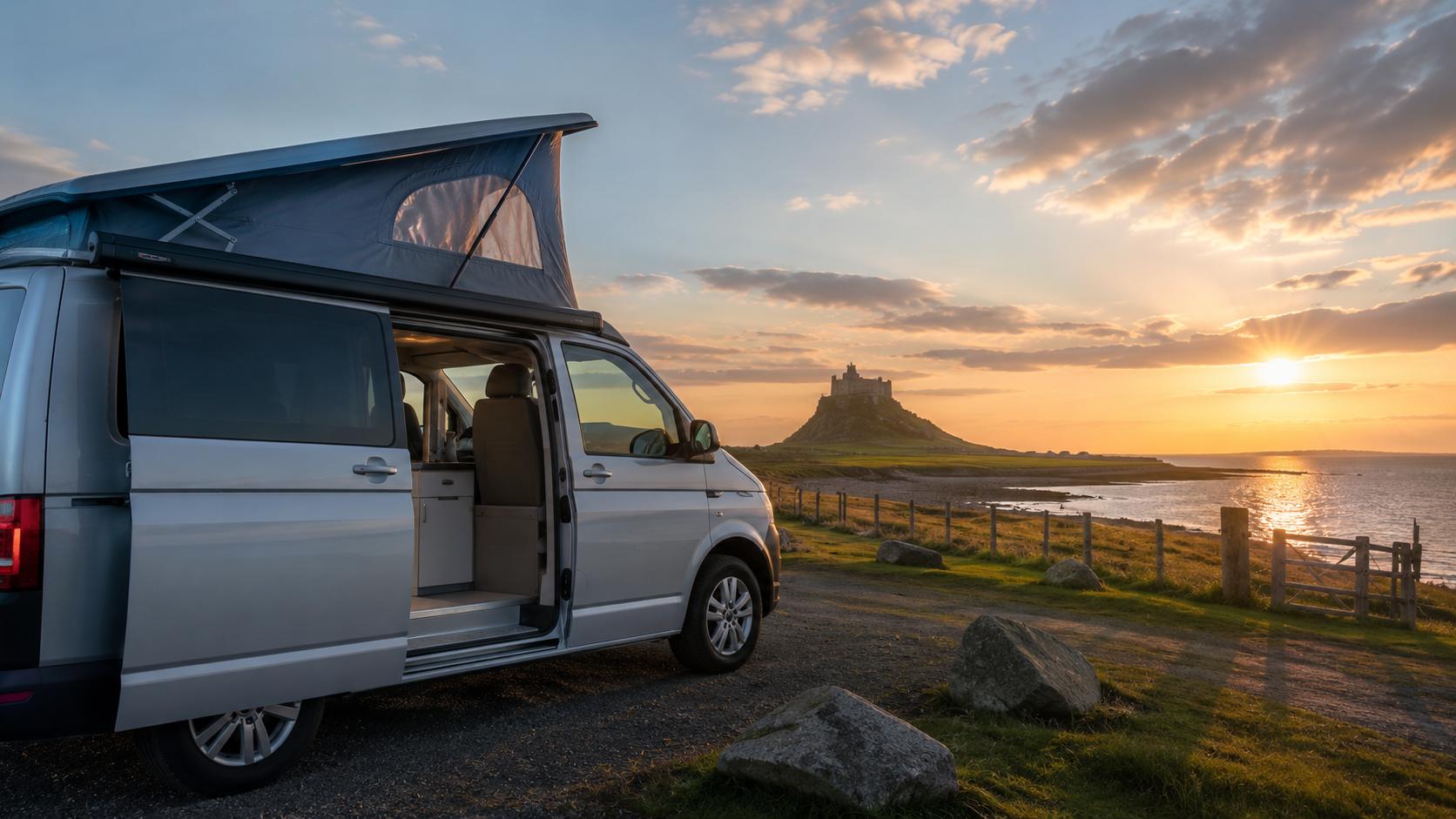
Northumberland looks, on paper, like the perfect campervan county. Enormous empty landscapes, a coastline of castles and beaches, dark skies, quiet roads and very few people. A great many owners arrive expecting Scotland-style freedom and discover that England works differently.
The touring here is genuinely excellent, but it requires planning around a legal framework that gives you considerably fewer rights than the vehicle's advertising suggests.
Wild camping is not legal in England.
This is the fundamental point and the source of most difficulty. Scotland's access legislation permits responsible wild camping on most unenclosed land. England has no equivalent, and camping anywhere without the landowner's permission is trespass.
That applies to a campervan parked overnight on a verge, in a layby, in a beauty spot car park or on a beach access road, whatever the vehicle's occupants intend to do there.
Pressure on the Northumberland coast in particular has led councils to introduce restrictions in coastal car parks, with height barriers, overnight parking prohibitions and enforcement, precisely because the volume of overnight vehicles became unmanageable and the associated waste problems became serious.
The practical position is that overnight stops need to be somewhere you are permitted to be, and there are plenty of those.
Where you can legitimately stay.
Campsites and caravan parks are the obvious answer, and Northumberland has a good spread of them from full-facility parks to basic field sites.
The membership clubs operate networks of small sites, including certificated locations limited to a handful of vans, frequently on farms and in places that feel considerably more remote than a commercial park. Membership pays for itself quickly for anyone touring regularly, and these small sites are the closest thing England offers to the freedom people are looking for.
Pub and farm stopover schemes allow overnight parking at participating businesses, generally on the understanding that you will buy a meal or a drink or some produce. These are excellent and underused.
A growing number of farms, breweries and rural businesses offer informal pitches, and asking a farmer directly frequently works, particularly out of season.
The road conditions require thought.
Northumberland's minor roads are narrow, unfenced across large areas of moorland, and shared with livestock, agricultural traffic and increasingly with cyclists.
Large motorhomes are genuinely difficult on some of these roads, and satellite navigation will route you down lanes it should not. Check the route rather than trusting the device, and be prepared to reverse a long way to a passing place.
Height and weight restrictions apply on some routes, including several bridges. The coastal villages have narrow streets and limited turning space, and arriving in a seven-metre vehicle at Craster in August is a decision you will regret.
Parking during the day is a separate problem from parking overnight, and many coastal car parks are simply too small for larger vehicles.
Facilities and waste.
Chemical waste disposal points are sparse in Northumberland compared with more established touring areas, and finding one should be part of the planning rather than an emergency.
Emptying waste anywhere other than a designated point is both illegal and the single behaviour that has done most to sour local attitudes towards touring vehicles. Grey water into a roadside drain, and worse, has driven a great deal of the restriction that now exists.
Water fill points are similarly limited. Carrying a full tank and topping up at campsites is the reliable approach.
Where the touring is best.
The coast between Amble and Berwick is the classic run, taking in Warkworth, Alnmouth, Craster, Dunstanburgh, Beadnell, Seahouses, Bamburgh and Lindisfarne, with campsites at intervals throughout.
The North Pennines and the South Tyne valley offer quieter touring with fewer visitors and some genuinely remote sites.
Kielder is a destination in its own right, with the reservoir, the forest, the observatory and some of the darkest skies in Europe. It is a long way from anywhere, which is exactly the point.
The Cheviots and the College Valley give access to serious hill country, with restricted vehicle access into some valleys requiring permits, which is worth checking in advance.
Timing changes everything.
Northumberland in July and August is busy on the coast and the sites fill. The same routes in May, June, September and October are quieter, cheaper and frequently blessed with better weather than the school holidays deliver.
Winter touring is entirely viable with a properly insulated vehicle, and the coast in a January gale is a memorable if not universally appealing experience. Many sites close for the winter, so check before setting off.
Being a good visitor.
The restrictions that now exist came from behaviour, and behaviour is what will determine whether more follow.
Stay where you are permitted, dispose of waste properly, take litter home, do not run generators near other people, park considerately, support local businesses and leave gates as you found them.
Northumberland's tourism economy matters enormously to the county, and touring visitors are welcome where they are welcome guests.
Share your thoughts.
Should England adopt Scottish-style access rights for responsible wild camping, or would that make the problem worse?
Travel News
Campervan and Motorhome Touring in Northumberland
Advertisement


Comments (0)
You must be logged in to post comments.
Don't have an account? Register here
No comments yet. Be the first to share your thoughts!