
Accommodation in Northumberland has become expensive. Cottages on the coast book out a year ahead at prices that put a weekend beyond a lot of families, and the hotels in the honeypot villages know exactly what they can charge in August.
There is an older network sitting underneath all of that, and it has survived every change in how people holiday. Hostels, camping barns and bothies offer somewhere to sleep for a fraction of the cost, and they put you in places that no hotel occupies.
Hostels are no longer what people remember.
The stereotype is of bunk rooms, compulsory chores and a warden locking the doors at ten. That model disappeared decades ago.
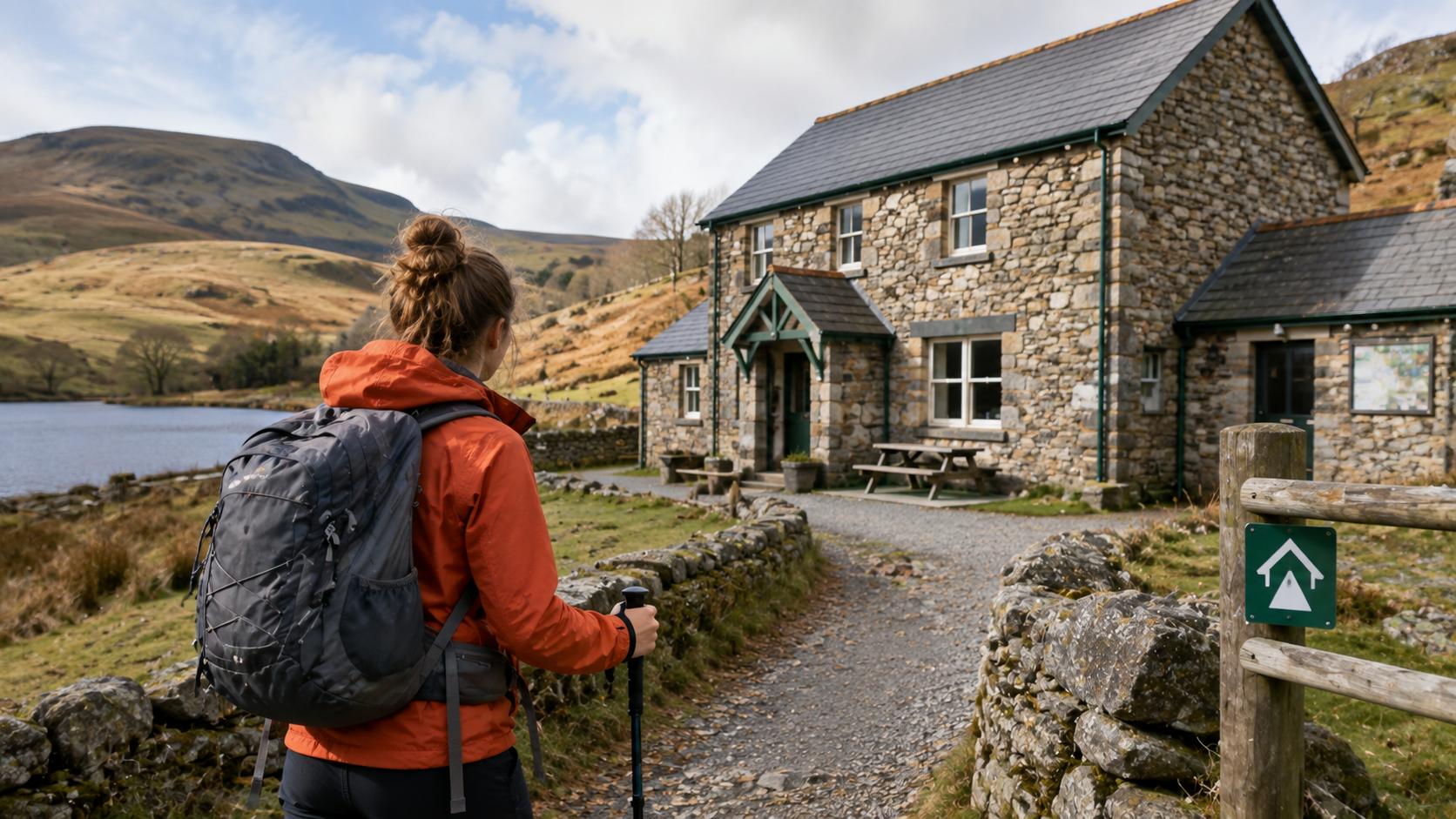
Modern hostels in the region offer private rooms as well as shared dormitories, en suite options, self-catering kitchens, drying rooms, cafés and bars, and family rooms that work out considerably cheaper than a hotel for four people.
They are used by walkers, cyclists, families, groups and people who simply want a cheap base, and nobody is going to make you sweep anything.
The self-catering kitchen is the underrated feature, since eating out for every meal is frequently the largest cost of a trip.
Where they are in the region.
The concentration is where the walking is. The central section of Hadrian's Wall has hostel provision, and the visitor centre and hostel complex near Once Brewed sits directly on the Wall with the Northumberland dark skies overhead.
Wooler serves the Cheviots and St Cuthbert's Way. The Northumberland coast has provision at intervals, and there are hostels serving the North Pennines.
Alongside the main hostelling association there are a good number of independent hostels and bunkhouses, frequently attached to pubs, farms or outdoor centres. These are often better value again and are worth seeking out, since they do not appear on the main booking sites.
Newcastle itself has hostel accommodation aimed largely at city visitors, which is useful for anyone visiting the region without a car.
Camping barns sit between camping and hostelling.
A camping barn is essentially a stone tent: a converted farm building with a sleeping platform, basic cooking facilities, a tap and a toilet, and not a great deal else.
You bring a sleeping bag and a mat, you cook your own food, and you pay very little. What you get is a roof, four walls and somewhere to dry out, which in Northumberland in October is worth a great deal more than it sounds.
They suit groups, families with older children and anyone who wants the outdoor experience without the tent, and they are frequently in genuinely remote locations.
Bothies are a different proposition entirely.
A bothy is an unlocked shelter in remote country, maintained by volunteers and free to use. There is no booking, no warden, no electricity, no water supply and usually no toilet. There may be a sleeping platform, a fireplace and a table.
The Mountain Bothies Association maintains a network across Scotland, northern England and Wales, including shelters in the Cheviots and the border country. Locations are published, and the association's website is the authoritative source.
Bothies are not a budget accommodation option in the ordinary sense. They exist for people travelling through remote country under their own steam, and turning up by car with a crate of beer is precisely the behaviour that has caused problems and closures elsewhere.
The bothy code, in short.
Leave it cleaner than you found it, and take all rubbish out, including anything left by others if you can carry it.
Do not overcrowd. Bothies are first come first served, and if a group arrives after you, the expectation is that you make room, but if the place is full you need a tent as a backup. Always carry one on a bothy trip.
Bring your own fuel. Burning the fabric of the building, the furniture, or scavenged live wood is unacceptable, and firewood in the Cheviots is scarce.
Bury human waste well away from the building and any water source, or better, carry it out.
Stay a night or two, not a fortnight. Bothies are for travellers, not for occupation.
Tell someone where you are going, because there is no phone signal, no warden and nobody expecting you.
Booking and cost.
Hostels and bunkhouses book online in the ordinary way and fill in season, particularly along the Wall and on the coast during school holidays. Midweek and out of season, availability is generally good and rates fall.
Membership of the hostelling association gives discounted rates and pays for itself over a few nights.
Bothies cannot be booked and cost nothing. The association that maintains them relies on membership subscriptions and donations, and joining is a reasonable thing to do if you use them.
What this network is for.
There is a genuine social purpose behind all of it. The hostel movement began to give people of modest means access to the countryside, and the bothy network exists so that remote country remains accessible to anyone prepared to walk into it.
Both are maintained substantially by volunteers, and both depend entirely on users behaving decently.
Share your thoughts.
Have you ever stayed in a bothy, and would the lack of facilities put you off?
Travel News
Youth Hostels and Bothies Across the North East
Advertisement


Comments (0)
You must be logged in to post comments.
Don't have an account? Register here
No comments yet. Be the first to share your thoughts!