
Some of the most significant reproductive science of the past thirty years has taken place in a building beside Newcastle Central Station. The work carried out at Newcastle University and the fertility centre at the Centre for Life put the city at the front of an international scientific and ethical argument, and made the United Kingdom the first country in the world to regulate and legalise a technique that had been theoretical everywhere else.
The shorthand the press settled on, three-person babies, is the phrase scientists involved dislike most, and understanding why explains most of what the technique actually does.
Mitochondria are not the part of you that makes you you.
Almost all human DNA sits in the nucleus of the cell, and that is the material that determines the characteristics people think of as inherited: appearance, build, the vast complexity of how a person develops. It comes from both parents in roughly equal measure.
Mitochondria are separate structures within the cell that generate the energy the cell needs to function, and they carry their own small circle of DNA containing a few dozen genes. That mitochondrial DNA is inherited exclusively from the mother, passed down the female line unchanged for generations, and it accounts for a vanishingly small fraction of a person's total genetic material.
Mitochondrial donation replaces the faulty mitochondria while retaining the nuclear DNA of both parents. A child born through it inherits their characteristics from their mother and father in the ordinary way. The third contribution is limited to the cellular machinery that produces energy, which is why the description of three parents is scientifically misleading even though it is technically accurate that material comes from three people.
The diseases involved are devastating.
Mitochondrial disease is not a single condition. It is a group of disorders caused by faults in mitochondrial function, and because every cell needs energy, the effects concentrate in the tissues that need the most: brain, heart, muscle, liver, eyes and ears.
The severity varies enormously. Some people live largely unaffected lives with mild symptoms. Others have children who deteriorate progressively from infancy, with seizures, loss of muscle control, blindness, deafness, organ failure and early death. Conditions including Leigh syndrome and MELAS sit at the severe end and have no cure.
For affected families the pattern is agonising and repetitive. A mother carrying a mitochondrial mutation may be mildly affected or entirely well, and yet may pass a devastating burden to a child, with the proportion of faulty mitochondria transmitted being largely unpredictable. Families have lost multiple children to the same condition without ever being able to know in advance what a pregnancy would bring.
Newcastle has been the centre for this in the UK for decades, with a nationally commissioned specialist service for patients with mitochondrial disease and a research programme that has been among the most productive in the world.
There are two techniques, and both move the nucleus.
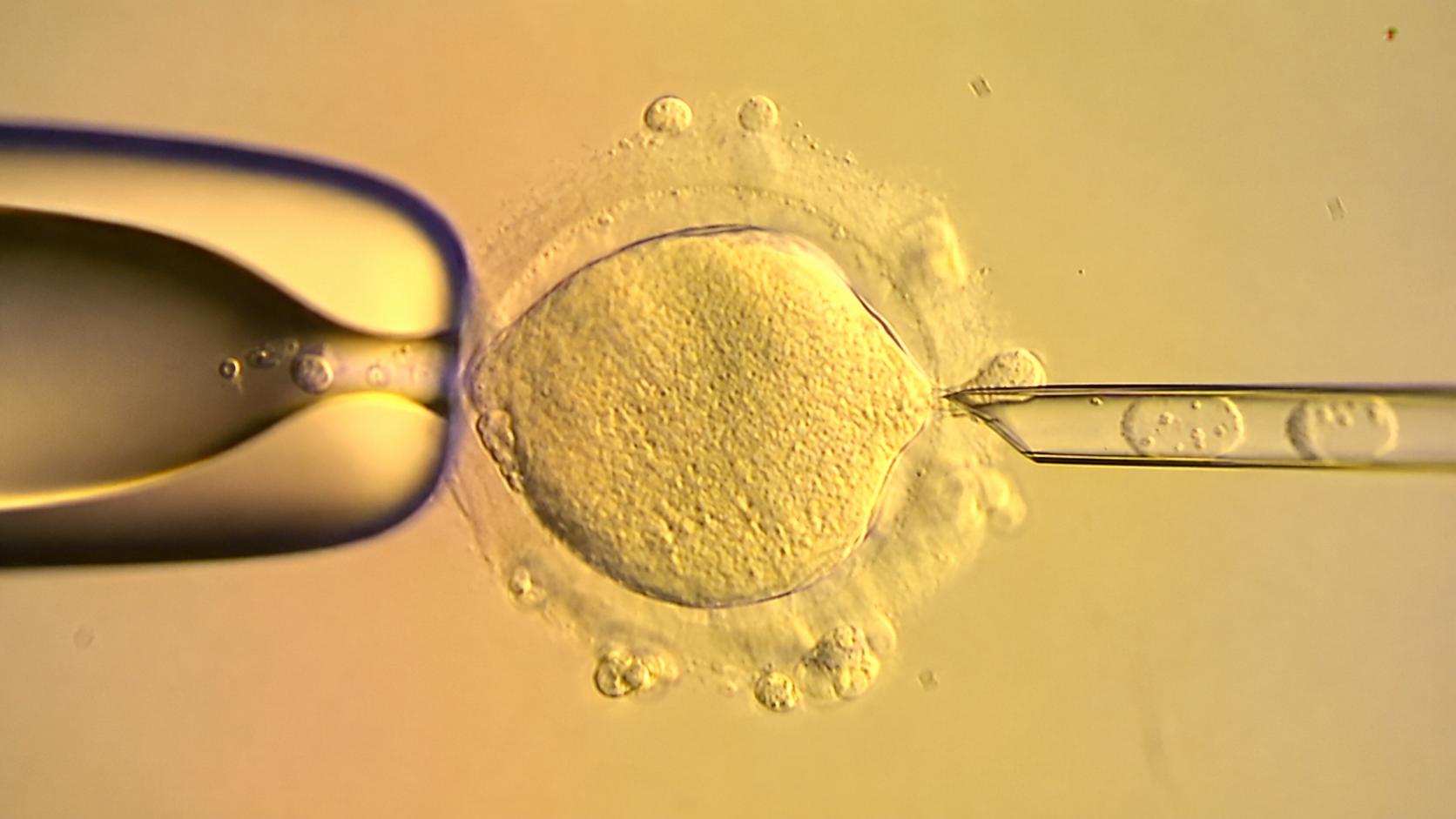
Maternal spindle transfer takes the nuclear genetic material from the mother's egg and transfers it into a donor egg that has had its own nuclear material removed but retains healthy mitochondria. That reconstructed egg is then fertilised.
Pronuclear transfer works after fertilisation. Both the mother's egg and the donor egg are fertilised, and the nuclear material from the mother's fertilised egg is transferred into the donor embryo, which has had its own nuclear material removed.
Both approaches achieve the same outcome by different routes, and the technical detail of which is used in a given case depends on clinical circumstances.
The UK legalised it deliberately and slowly.
Britain did not arrive at this by accident. It followed years of scientific review, public consultation, ethical debate and parliamentary scrutiny, culminating in regulations passed in 2015 that permitted mitochondrial donation under strict conditions.
The Human Fertilisation and Embryology Authority regulates the process, and Newcastle received the first licence to carry it out. Crucially, permission is granted case by case. A clinic cannot simply offer the technique to anyone who asks; each patient's circumstances are assessed and approved individually against criteria concerning the risk to any child.
That regulatory architecture is the reason the UK became the first country to do this lawfully. The science existed elsewhere, but no other jurisdiction had built a framework capable of authorising it.
The results have now been published.
In 2025 the Newcastle team published findings in a leading medical journal reporting on the outcomes of the programme, including the births of eight babies following the use of pronuclear transfer, alongside detailed data on the proportion of faulty mitochondria carried forward.
The findings were broadly encouraging, with the children reported as developing normally, and with mitochondrial mutation levels in most cases undetectable or very low. In a small number, some carryover of maternal mitochondria was detected at higher levels than hoped, which is precisely the kind of finding that long-term follow-up exists to identify.
The scientific position remains that this is a technique requiring careful long-term monitoring rather than one that can be declared finished. Follow-up of the children continues.
The ethical arguments have not gone away.
Objections were raised at the time and have not disappeared. They include the position that this constitutes germline modification, because changes are inheritable by female children and their descendants, and that this crosses a line other genetic interventions do not.
Concerns were also raised about the donor's position, about long-term safety being unknowable in advance, and about the slippery slope towards genetic selection for characteristics rather than disease avoidance.
Supporters point out that the technique alters no nuclear genes, that the alternative for many families is either childlessness, donor eggs entailing no genetic connection at all, or the birth of children who will suffer and die, and that the regulatory framework is deliberately narrow.
Both sets of arguments were heard fully in Parliament, which is more than can be said for how these decisions have been made in some other jurisdictions.
Why it matters to Newcastle.
Cities are known for things, and Newcastle's scientific reputation has historically rested on engineering, shipbuilding and the industrial past. This is a different kind of claim, and a substantial one.
It also has practical consequences locally. The concentration of expertise means patients and families from across the UK come to Newcastle for mitochondrial disease care, and the research base attracts funding, staff and further work into the city.
If you are affected by mitochondrial disease, care is provided through the NHS specialist service, and your GP or consultant can advise on referral.
Share your thoughts.
Was Britain right to legalise mitochondrial donation ahead of the rest of the world?
Health News
Newcastle and the World's First Three-Person Babies
Advertisement





Comments (0)
You must be logged in to post comments.
Don't have an account? Register here
No comments yet. Be the first to share your thoughts!