
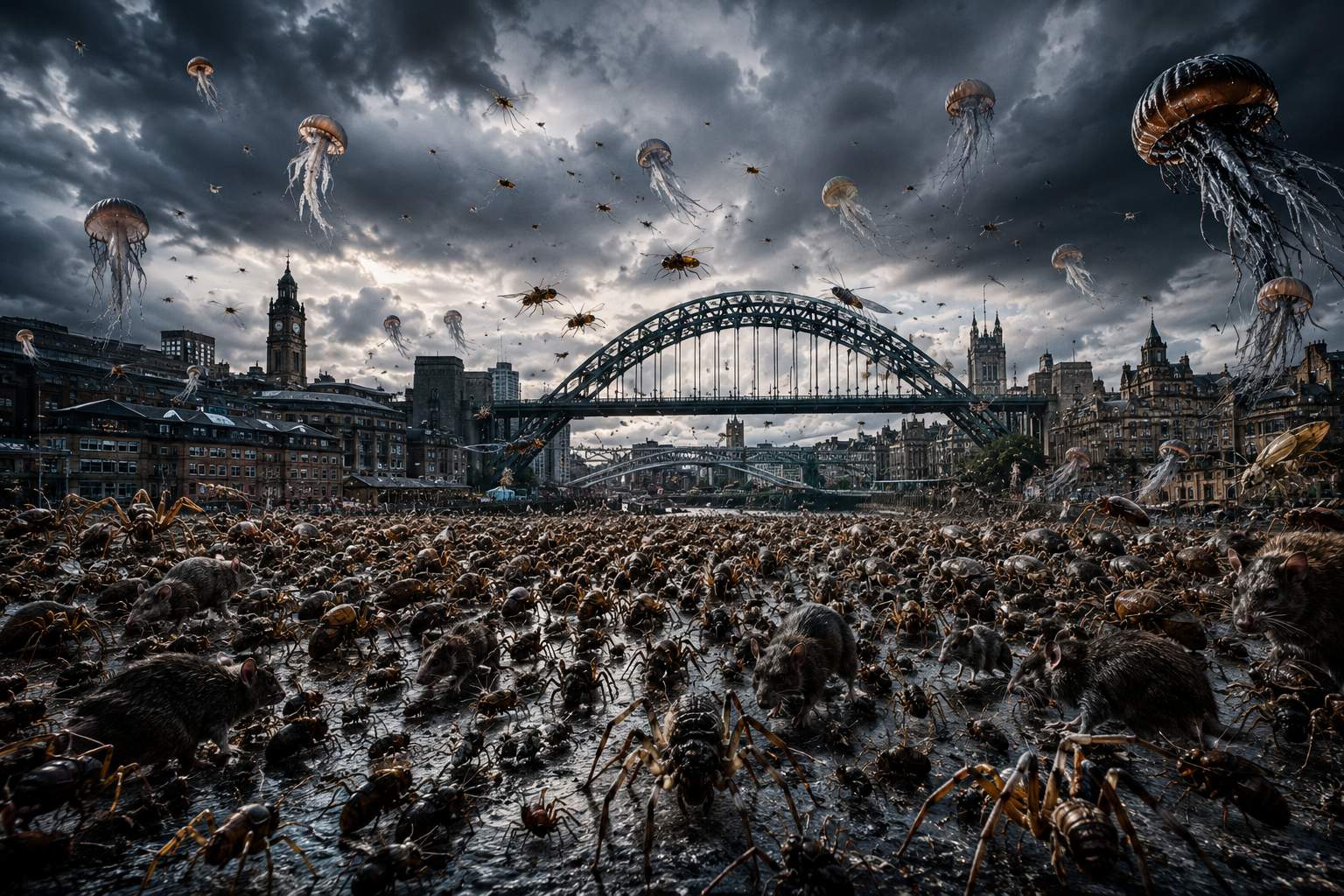
Humanity has conquered continents, landed on the Moon and built cities visible from space. Yet if Earth's most numerous and resilient creatures suddenly worked together with one goal, humans could find themselves facing an impossible battle.
Thankfully, this is pure speculation. Nature does not operate like a Hollywood disaster film. But it raises a fascinating question. Which animal populations would pose the greatest threat if they somehow united against humanity?
Looking at global population estimates, survival abilities and links to the North East, five species groups stand out. Some are obvious. Others may come as a surprise.
Spiders Would Be Humanity's Silent Nightmare.
Most people are relieved to learn that spiders are more afraid of us than we are of them. However, their sheer numbers are staggering.
Scientists estimate there are around 25 million tonnes of spiders living on Earth at any given time. Researchers have previously calculated that spiders collectively consume between 400 and 800 million tonnes of prey every year, making them among the planet's most efficient predators.
While the vast majority are harmless to humans, their biggest weapon would be numbers. If every spider on Earth suddenly acted in coordination, they would be almost impossible to avoid.
The North East is home to hundreds of spider species, from common garden spiders found across Newcastle to wolf spiders inhabiting coastal dunes and moorland habitats. Biodiversity records show spiders form a significant part of Britain's ecosystem.
Imagine millions of spiders occupying homes, transport networks and food storage facilities simultaneously. Even without deadly venom, the psychological impact alone would likely trigger mass panic.
For Newcastle's population of more than 320,000 residents, the sight would be enough to empty city centres overnight.
Ants Could Outnumber Every Human Millions Of Times Over.
If spiders are the nightmare fuel, ants are the logistical masterminds.
A landmark study estimated there are roughly 20 quadrillion ants on Earth. That is 20,000,000,000,000,000 individuals. Scientists believe their combined biomass outweighs many larger animal groups combined.
Ant colonies already demonstrate military-style organisation. Some species wage war against rival colonies, conduct coordinated raids and even farm fungi for food.
If ants somehow developed a collective strategy against humanity, they could attack infrastructure, food supplies and agriculture on a global scale. Their ability to infiltrate tiny spaces would make them difficult to stop.
The UK has dozens of ant species, including populations across the North East's parks, woodland areas and coastal habitats. While individually harmless, their strength has always been collective action.
In a fictional battle for survival, ants might become humanity's most relentless opponent.
Mosquitoes Already Kill More Humans Than Any Other Animal.
When people think about dangerous animals, sharks often come to mind. The reality is far different.
Mosquitoes are widely regarded as the deadliest animals on Earth because of the diseases they spread. Malaria, dengue fever and other mosquito-borne illnesses kill hundreds of thousands of people globally each year.
Scientists estimate mosquito populations number in the trillions. Their reproduction rates are extraordinary. Some species can lay hundreds of eggs at a time, creating population explosions under favourable conditions.
The UK's climate has traditionally limited mosquito-related health threats, although warming temperatures have prompted increasing discussions among experts about how insect populations may shift in future decades.
The North East has its own native mosquito populations, particularly around wetlands, rivers and coastal environments. While they are mostly a nuisance rather than a serious health threat, their presence highlights just how widespread these insects are.
If mosquitoes somehow coordinated globally, their ability to spread disease would make them arguably the most effective biological threat humanity could face.
Rats Have Been Following Humans For Centuries.
Rats may be one of the few animals already thriving wherever humans live.
Estimates vary widely, but many urban ecologists believe rat populations can equal or even exceed human populations in major cities. Some studies have suggested there may be hundreds of millions, if not billions, of rats worldwide.
Their success comes from adaptability. Rats can swim, climb, squeeze through tiny gaps and survive on almost any food source.
Newcastle and other major UK cities continuously invest in pest control efforts because rats remain a persistent urban challenge. Ports, rivers and dense housing areas create ideal environments for rodent populations.
Historically, rats have been associated with some of humanity's worst disease outbreaks, although modern science has dramatically reduced those risks.
If rats suddenly worked together, they could disrupt food chains, contaminate supplies and damage infrastructure at a scale rarely seen before.
Unlike many wild animals, rats already know exactly where humans live.
Jellyfish Might Be The Most Surprising Threat.
Many people would expect a list like this to include lions or bears. Instead, one of the most shocking contenders is the jellyfish.
Around the world, scientists have documented increasing jellyfish blooms in some regions. These huge gatherings can contain millions of individuals.
Jellyfish already cause significant problems for coastal communities by damaging fishing operations, affecting tourism and occasionally shutting down power stations when they clog cooling systems.
The North East coast regularly experiences jellyfish sightings during warmer months, with beachgoers from Tynemouth to Sunderland occasionally spotting large numbers washed ashore.
While jellyfish are unlikely to launch a direct attack on humanity, their ability to disrupt marine ecosystems makes them a fascinating candidate. Oceans provide a substantial proportion of the world's food supply. Any species capable of dramatically altering marine environments could indirectly affect human survival.
Their inclusion highlights an important reality. The greatest threats are not always the biggest animals.
Could They Actually Defeat Humanity.
The short answer is no.
Humanity's greatest advantage is cooperation, technology and adaptability. The global human population now stands at nearly 70 million in the UK alone and around eight billion worldwide.
Even if spiders, ants, mosquitoes, rats and jellyfish somehow united, humans possess advanced medicine, agriculture, engineering and communication systems that no animal species can match.
However, the thought experiment reveals something important.
Many of the creatures on this list already influence our daily lives. Mosquitoes affect public health. Rats challenge urban management. Jellyfish impact marine industries. Ants and spiders play critical roles in ecosystems.
The reality is that these species do not need to defeat humanity to have a profound impact on society.
What Newcastle And The North East Can Teach Us About Nature.
The North East remains one of Britain's most ecologically diverse regions, from the River Tyne and Northumberland coastline to extensive countryside habitats.
The region is home to countless species that quietly maintain ecological balance. Spiders help control insect populations. Ants improve soil quality. Even creatures often viewed as pests contribute to broader ecosystems.
With the North East's population reaching around 2.5 million and Newcastle itself exceeding 320,000 residents, the relationship between people and wildlife continues to evolve.
Rather than fearing these animals, scientists increasingly focus on understanding them. The more researchers learn about population dynamics, the better equipped society becomes to manage environmental challenges.
One thing remains certain. If Earth's most numerous creatures ever did decide to work together, humanity would have a very interesting problem on its hands.
Share your thoughts.
What do you think would be humanity's toughest animal opponent if nature suddenly united?
Entertainment News
The Shocking Animal Army That Could Challenge Humanity's Survival
Advertisement





Comments (0)
You must be logged in to post comments.
Don't have an account? Register here
No comments yet. Be the first to share your thoughts!