
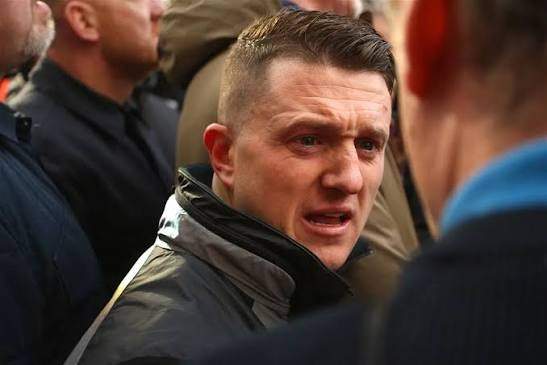
Tommy Robinson has once again found himself at the centre of national attention after being detained by police at Heathrow Airport under powers contained within the Counter-Terrorism and Border Security Act 2019. The incident comes at a time when far-right demonstrations and counter-protests have been taking place across several parts of the UK, including Newcastle, where community tensions have remained a major talking point over recent weeks.
The activist, whose real name is Stephen Yaxley-Lennon, was stopped by officers after arriving back in the UK from Russia via Turkey. According to reports, he was questioned for almost three hours and had mobile phones seized during the process. The Metropolitan Police confirmed that a man in his 40s had been stopped under Schedule 3 powers, which allow authorities to question and search individuals at UK borders to determine whether they may have been involved in hostile activity.
What happened at Heathrow Airport.
Details surrounding the specific reasons for the stop have not been publicly disclosed. Robinson later claimed on social media that authorities confiscated both his iPhone and Samsung device. Supporters described the detention as an attack on free speech, while critics argued that police were carrying out powers granted under existing legislation.
The Counter-Terrorism and Border Security Act 2019 gives officers broad powers at ports and airports. These measures were introduced to help identify potential hostile activity and allow investigators to access information when national security concerns arise. Similar legislation has been used in previous high-profile cases involving individuals crossing UK borders.
The Heathrow incident has reignited debate around the balance between national security, privacy rights and freedom of expression, particularly when controversial public figures are involved.
Connection to recent Newcastle demonstrations.
Although Robinson's detention occurred hundreds of miles from Tyneside, the story has immediate relevance to Newcastle. Over recent weeks, the city has experienced several demonstrations linked to immigration, asylum accommodation and wider concerns surrounding migration policy.
Groups opposed to immigration policies have staged protests in parts of Newcastle, while anti-racism campaigners and community organisations have organised counter-demonstrations calling for unity and inclusion. Reports from local observers indicate that anti-fascist gatherings have significantly outnumbered far-right activists at several events.
Newcastle has become one of several UK cities where national political debates are increasingly being played out on local streets. While the vast majority of demonstrations have remained peaceful, police have continued to monitor events closely to prevent disorder and ensure public safety.
The renewed spotlight on Robinson is likely to generate further discussion among both supporters and opponents in the North East, particularly as social media continues to amplify political messages and organise demonstrations.
Social media's growing influence on public demonstrations.
One of the most significant developments in recent years has been the role of social media in mobilising protests. Robinson's online following has grown considerably, and his posts frequently reach millions of users through shares, reposts and endorsements from influential accounts.
Experts have repeatedly warned that incidents involving crime, immigration or public disorder can spread rapidly online before all facts are established. Research organisations monitoring extremism and misinformation have highlighted how viral content can accelerate tensions and encourage demonstrations within hours of an event occurring.
This trend has been visible in Newcastle and elsewhere across the UK, where local issues are increasingly linked to wider national campaigns and online movements.
Statistics that reveal the scale of the challenge.
Recent figures underline why authorities remain concerned about protest-related disorder and extremist activity.
During the widespread unrest that affected parts of Britain in 2024, more than 1,800 arrests were made and over 300 police officers were injured, according to reports examining anti-immigration riots and associated disorder across the country.
In Southampton, where Robinson recently supported demonstrations following the death of teenager Henry Nowak, clashes reportedly left 13 police officers and a police dog injured.
Meanwhile, one of Robinson's social media posts promoting demonstrations was reportedly shared by Elon Musk, whose account reaches around 240 million followers, highlighting the enormous potential reach of political messaging online.
For residents in Newcastle, these figures demonstrate how local protests can quickly become part of much larger national conversations.
A controversial figure with a long history in the spotlight.
Robinson remains one of Britain's most divisive political activists. As the former leader of the English Defence League, he has spent years at the centre of debates surrounding immigration, Islam, free speech and public protest.
His supporters argue that he raises issues they believe mainstream politicians ignore. Critics, however, accuse him of inflaming tensions and contributing to divisions within communities.
The Heathrow detention is not the first time Robinson has encountered counter-terrorism legislation. In 2024, he was stopped while travelling through the Channel Tunnel and later faced legal proceedings after refusing to provide access to his mobile phone. He was subsequently cleared of the offence after a court found questions over the legality of the stop.
That previous case continues to be referenced by supporters who believe border security powers are being used too broadly.
What happens next.
At the time of writing, police have not confirmed whether any further action will be taken following Robinson's Heathrow detention. The investigation remains ongoing, and authorities have not publicly disclosed the precise grounds for the stop.
For Newcastle, the wider issue is likely to remain the focus. Community leaders, campaign groups and local residents continue to debate how best to respond to demonstrations while preserving public safety and protecting the right to peaceful protest.
As tensions around immigration, social cohesion and national identity continue to dominate headlines, cities such as Newcastle are increasingly finding themselves at the centre of discussions that stretch far beyond the North East.
The coming weeks may reveal whether Robinson's latest encounter with police becomes another chapter in an already controversial career, or a catalyst for further debate about protest movements and political activism across Britain.
Join the Conversation.
What are your thoughts on the recent Newcastle demonstrations and the growing influence of national political figures on local events?
Political News
Tommy Robinson Detained Under Counter-Terror Powers After Russia Trip
Advertisement


Comments (0)
You must be logged in to post comments.
Don't have an account? Register here
No comments yet. Be the first to share your thoughts!